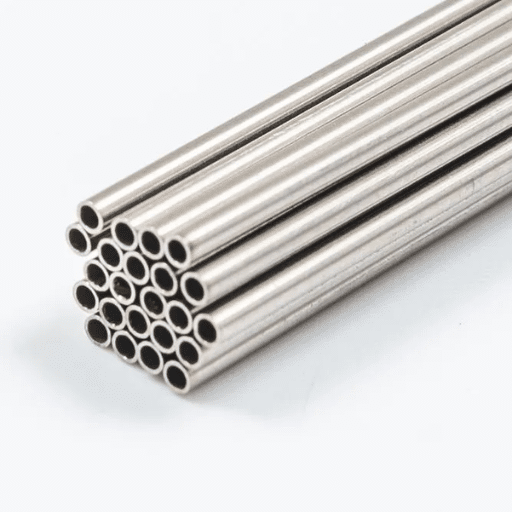
904L stainless steel pipe (UNS N08904 / EN 1.4539) is a super-austenitic pipe supplied to ASTM A312 in grade TP904L, in the solution-annealed and pickled condition. Seamless runs about ½” to 16″ NB in schedules 5S through XXS; welded and EFW extend to 24″ and 100″ NB, in 6 m or 12 m lengths.
A 904L pipe order is decided by five lines: the standard, the form (seamless or welded), the size basis (NB or OD × wall), the test basis, and the end finish. Get the third one wrong and the pipe that arrives does not fit. Get the first one wrong and it is not certified to the standard your line design assumed.
That is why this SERP is a problem. Almost every 904L pipe page on the first page of results cites ASTM B677 as the seamless standard for the grade, a specification whose current edition lists N08925, N08354 and N08926, not N08904. N08904 appeared in the 1990s and 2004-era editions. The same pages then use “pipe” and “tube” as if they were one product, when they are ordered on two different bases and are not interchangeable.
This guide is written for the person writing the specification, not the person browsing a catalogue. It sits inside our complete 904L stainless steel guide and the wider stainless steel grade range we supply.
Key Takeaways
- 904L pipe is governed by ASTM A312, grade TP904L (UNS N08904). The current B673 / B674 / B677 scopes cover N08925, N08354 and N08926. N08904 was in the 1990s and 2004-era editions, so the B-series citations on most supplier pages are legacy, not current.
- Pipe is ordered by nominal bore to a fixed OD (ASME B36.19M). Tube is ordered by actual OD × wall to tighter tolerances (A213 / A249 / A269). A 2″ NB pipe has a 60.3 mm OD, so it is not a 2″ OD tube.
- Hydrostatic testing, or NDT in lieu, is mandatory, and the marking tells you which.
NHmeans not hydrotested,ETeddy current,UTultrasonic.- Seamless runs roughly ½”–16″ NB; welded and EFW extend to 24″ and 100″ NB. Welded-and-cold-drawn is the third option almost nobody quotes.
- Verify Cu (1.0–2.0%) and Mo (4.0–5.0%) by PMI on receipt. Those are the two lines a substitute grade fails first.
- 904L pipe is not a warm-chloride grade. PREN 34–36 is below the ≥ 40 seawater convention, HCl is limited to roughly 1–2%, and service is capped near 400–450 °C.
Specifying a line? Send us the form, size basis, schedule, length, end finish and test basis, and our engineers will confirm availability, certification and a quotation with MTR and PMI within 24 hours. Request a 904L pipe quotation.
What Is 904L Stainless Steel Pipe?

Definition
904L pipe is a low-carbon, high-nickel austenitic stainless pipe with a deliberate copper addition, supplied for corrosion and pressure service and ordered to a stated standard, schedule and test basis rather than to a gauge.
Designations You Will See on the MTR
904L is one grade wearing several names, and a pipe certificate will usually print two or three at once:
UNS N08904 · EN/DIN 1.4539 · X1NiCrMoCu25-20-5 · AISI 904L · JIS SUS 890L · Swedish SS 2562 · trade name Uranus B6. The Chinese designations are S31782 (digital), 015Cr21Ni26Mo5Cu2 (current) and 00Cr20Ni25Mo4.5Cu (superseded) under GB/T 20878. Our 904L equivalent grades table maps the full cross-reference.
The chemistry is what makes a pipe purchase testable: Cr 19.0–23.0%, Ni 23.0–28.0%, Mo 4.0–5.0%, Cu 1.0–2.0%, carbon capped at 0.020%. It is identical for seamless and welded product, which is worth stating plainly because buyers routinely assume the chemistry changes with the form. It does not.
Pipe vs Tube: The Distinction That Decides Whether It Fits
“904L pipe” and “904L tube” are used interchangeably across the internet, which is exactly why size claims contradict each other (OD 6–219 mm, 6–600 mm, 6–630 mm, “½”–24″ NB” and “1/8″–48″” all appear in the same results). The definitions are exact and commercially decisive:
| Basis | Pipe | Tube |
|---|---|---|
| Specified by | Nominal bore (NB / NPS / DN) | Actual outside diameter |
| Outside diameter | Fixed by NB, tabulated | Whatever is ordered |
| Wall chosen by | Schedule (5S, 10S, 40S, 80S…) | Actual wall thickness or gauge |
| Dimensional standard | ASME B36.19M (S schedules) / B36.10M | A213 / A249 / A269 |
| Tolerance | Looser | Tighter |
| Named as | 2″ NB, 6″ NB | 25.4 mm OD × 2.11 mm WT |
| Typical service | Process, transfer, utility lines | Heat exchangers, condensers, instruments |
Here is the trap. A 2″ NB pipe has a 60.3 mm outside diameter, not 50.8 mm. It is not a 2″ OD tube. Order on the wrong basis and the size that arrives will not fit the line or the tubesheet it was bought for.
Which Standard Governs 904L Pipe? A312 and the B-Series Legacy
This is the section that matters most, because it is where most of the search results are wrong and where a real purchasing decision hangs.
ASTM A312 TP904L: What Actually Certifies 904L Pipe
ASTM A312/A312M is the specification for seamless, welded, and heavily cold-worked austenitic stainless steel pipe, and it lists grade TP904L, UNS N08904. This is the standard a 904L pipe MTR will actually name, and it is the standard to write on a new purchase order. For high-temperature EFW pipe, 904L also reaches service through ASTM A358. The mechanical minimums it invokes for the annealed condition are a recap here: tensile ≥ 490 MPa, 0.2% yield ≥ 220 MPa, elongation ≥ 35%. Our 904L properties reference carries the full data and the cross-form minimums comparison.
Which ASTM Standard Covers 904L Pipe?
ASTM A312, grade TP904L. The often-cited B-series specifications, B677 (seamless pipe and tube), B673 (welded pipe) and B674 (welded tube), currently cover UNS N08925, N08354 and UNS N08926, not N08904. N08904 appeared in superseded editions such as B677-99 and B677-04a. Verify the edition before it goes on a purchase order.
B673 vs B674 vs B677: Getting the Assignment Right
The SERP cannot agree on what each B-series specification covers, so here is the mapping taken from the current titles themselves:
| Specification | Current coverage | Legacy for 904L? |
|---|---|---|
| ASTM B673 | UNS N08925, N08354, N08926, welded pipe | Yes, B673:1996 listed N08904 |
| ASTM B674 | UNS N08925, N08354, N08926, welded tube | Yes, B674:1996 listed N08904 |
| ASTM B677 | UNS N08925, N08354, N08926, seamless pipe and tube | Yes, B677:1999 / -04a listed N08904 |
| ASTM A312 / ASME SA312 | Austenitic pipe, grade TP904L (N08904) | Currently, this is the governing standard |
The contradiction is proof nobody checked. One competitor calls B673 welded pipe, another calls it seamless tube, and a third calls B674 welded pipe. Read the standard’s own title: B673 is welded pipe, B674 is welded tube, B677 is seamless pipe and tube, and none of them currently list N08904.
Why B677 Still Appears, and What to Do About It
B677 is deeply embedded in legacy documentation, and it will keep appearing for years. A piping package specified in 2011 said B677 because that is what the datasheet of the day said. Handle it the same way you would handle any superseded call-out:
- Do not silently “correct” an approved specification. A standard change on a released drawing needs engineering sign-off, because other clauses may reference it.
- Do know what your pipe is actually certified to. If the MTR comes back citing A312 TP904L, the material is right; the question is whether your release procedure accepts it against the B677 call-out.
- Write A312 TP904L on new orders.
Priya, a piping engineer on a European acid-plant expansion, hit this in March 2026. The line list carried “ASTM B677” from a 2011 datasheet; the mill certificate for the delivered seamless pipe cited A312 TP904L. The pipe was correct, the certificate was correct, and QA still held the shipment for three days while compatibility was cleared. Her fix was a one-line note in the specification register: 904L tubular product is an A312 grade today, and a B-series reference is legacy. The next shipment cleared the same afternoon.
European, Japanese and Chinese Product Standards
For projects outside the ASTM system, the product standards differ from the grade designations:
| Region | Seamless pipe | Welded pipe/tube |
|---|---|---|
| Europe (pressure) | EN 10216-5, grade 1.4539 | EN 10217-7, grade 1.4539 |
| Japan | JIS G3459, SUS 890L | JIS G3463, SUS 890L |
| China | GB/T 14976 | GB/T 12771 |
The European and Japanese standards map cleanly onto A312 for grade and test basis, and a CE-marked package routes through the Pressure Equipment Directive with EN 10204 3.1 certification as standard. Where the Chinese product standards appear on a domestic MTR, pair them with the GB/T 20878 grade designation so the certificate and the design code reference the same grade.
Seamless, Welded and Welded-and-Cold-Drawn

There is a third option that almost nobody quotes. It sits between seamless and plain welded, and for many duties it is the correct one.
Seamless (A312 SMLS)
A pierced billet is rolled to size with no seam, giving the highest pressure rating and the least inspection obligation on a longitudinal weld. It is the default for high-pressure and cyclic service, and the default for small-bore lines.
Welded (ERW / EFW)
Electric-resistance welded (ERW) covers ½”–24″ NB; electric-fusion welded (EFW) extends to 6″–100″ NB, and one supplier claims welded pipe to 1174 mm OD, which we treat as an outlier. Welded pipe gives larger diameters and longer lengths, but the weld seam must be pickled and passivated to restore the passive film. Write that as a deliverable requirement, not an assumption.
Welded-and-Cold-Drawn: The Middle Option
The welded tube is cold-reduced by at least 35% of wall thickness before final annealing. That recovers much of the integrity and dimensional consistency of seamless at a lower cost, and it is the basis of the heavily cold-worked form A312 names. It is the right answer when a specification says “seamless only” for reasons of habit rather than pressure.
Which One for Which Service
| Seamless (SMLS) | Welded (ERW / EFW) | Welded-and-cold-drawn | |
|---|---|---|---|
| Pressure rating | Highest | Depends on weld quality | Near-seamless |
| Size range | ~½”–16″ NB | ERW to 24″, EFW to 100″ NB | Typically small bore |
| Relative cost | Highest | Lowest | Middle |
| Weld seam | None | Full-length, needs pickling | Cold-reduced ≥ 35% |
| Best for | High pressure, cyclic, small bore | Large diameter, long length | Cost-sensitive small bore |
Why the seam matters in a corrosion sense, rather than a pressure sense, is covered in our 904L corrosion resistance guide.
904L Pipe Sizes, Schedules and Tolerances
The alloy does not change the dimensions. 904L pipe is dimensioned to ASME B36.19M for the “S” schedules and B36.10M for the non-S schedules, exactly like every other austenitic grade. That is what makes a size table useful rather than supplier-specific.
| NB (NPS) | OD (mm) | Wall 5S | Wall 10S | Wall 40S | Wall 80S | kg/m 10S | kg/m 40S |
|---|---|---|---|---|---|---|---|
| ½” | 21.3 | 1.65 | 2.11 | 2.77 | 3.73 | 1.02 | 1.29 |
| 1″ | 33.4 | 1.65 | 2.77 | 3.38 | 4.55 | 2.13 | 2.54 |
| 2″ | 60.3 | 2.11 | 3.05 | 3.91 | 5.54 | 4.38 | 5.53 |
| 4″ | 114.3 | 2.11 | 3.05 | 6.02 | 8.56 | 8.51 | 16.3 |
| 6″ | 168.3 | 2.77 | 3.40 | 7.11 | 10.97 | 14.1 | 28.7 |
| 10″ | 273.1 | 3.40 | 4.19 | 9.27 | 15.09 | 28.3 | 61.3 |
Wall thickness in mm. Weight is derived from a density of 7.95–8.0 g/cm³, using kg/m = (OD − WT) × WT × 0.02507. It is a calculated, indicative figure, not a mill weighbridge reading.
Seamless and Welded Ranges
Seamless 904L pipe spans roughly ½”–16″ NB; some suppliers offer 1/8″–24″ or quote an OD range of 6–630 mm. ERW welded covers ½”–24″ NB and EFW welded 6″–100″ NB. Published ranges genuinely conflict across the market, so treat any single figure as supplier-dependent and confirm the range for your size before quoting.
Schedules
Per B36.19M, the stainless schedules are 5S, 10S, 40S and 80S. The non-S schedules, SCH 5, 10, 20, 30, 40, 60, 80, 100, 120, 140, 160, plus STD, XS and XXS, follow B36.10M. Stock is commonly held in SCH 10, 40, 80 and 160.
Lengths, Tolerances and Straightness
Standard lengths are single random (5–7 m), double random (11–13 m), 6 m, 12 m, or cut to a stated length. The classic seamless wall tolerance is a −12.5% allowance on nominal wall, but the hot-finished and cold-finished rows differ; confirm the applicable row in A312/A999 for your form. Straightness for heat-exchanger tube is typically 0.8–1.5 mm/m.
Stock and cut-to-length capability for the full tubular range sits on our stainless steel pipe page.
Ends, Bevels and the Fittings That Match
Pipe is quoted by the metre and bought as a welded system, so the end finish and the fittings chain belong on the same RFQ.
- Plain end for socket-weld, compression or mechanical joints; also the default for heat-exchanger tube.
- Beveled end per ASME B16.25 for butt-welded lines, the bevel angle and root face are standardised, so state “beveled to B16.25” rather than “beveled.”
- Threaded end for small-bore utility and instrument lines, where it is still common.
The complementary items are specified per matched standards, and a supplier who maps them is the one who gets the package: buttweld fittings to ASTM A403 grade WP904L, forged fittings and flanges to ASTM A182 grade F904L, dimensioned to B16.9 / B16.28 / B16.5 / B16.47, joined with ER385 filler. Our 904L welding guide covers the procedure science; the pipe-specific point is that low carbon means no post-weld heat treatment is generally required, but the weld seam still requires pickling and passivation to restore the passive film, and that belongs in the PO.
Mandatory Testing: Hydrostatic, Eddy Current, Ultrasonic
“Hydrotested and NDT available” is a marketing bullet, not a specification. Here is what is actually required, from A999/A999M, so you can put it on the PO and audit against it.
Hydrostatic Test, and the NH Marking
For OD over 3.5 in. (88.9 mm), the referenced hydrostatic pressure is 2800 psi [19.0 MPa]; higher pressures are permitted at the manufacturer’s option or by agreement. A999/A999M requires the certification to state whether or not the material was hydrostatically tested, and requires the marking NH when it was not. Hydrostatic testing is frequently waived on small-bore or thin-wall product, which is exactly when that marking is the thing to check.
Eddy Current and Ultrasonic in Lieu
Where the purchaser accepts it, eddy current per Practice E426 or ultrasonic per Practice E213 may replace the hydrostatic test. The marking must then carry ET or UT. The acceptance criteria are specific:
- Eddy-current reference holes (E426): drilled through-holes by NPS, 0.039 in. [1.0 mm] at NPS ½, 0.055 in. above ½ to 1¼, 0.071 in. above 1¼ to 2, 0.087 in. above 2 to 5, 0.106 in. above 5. Notch depth ≤ 12% of nominal wall or 0.004 in. Maximum coil frequency 100 kHz (wall ≤ 0.050 in.), 50 kHz (≤ 0.150 in.), 10 kHz above.
- Ultrasonic reference notches (E213): depth ≤ 12% of nominal wall or 0.004 in., width ≤ 2× depth, on both OD and ID; transducer ≥ 2.00 MHz.
- General: NDT runs after all mechanical processing, heat treatment and straightening; operators certified to SNT-TC-1A; standardization at the start and end of each run and at intervals not exceeding 4 hours.
The Markings, Decoded
The marking on the pipe is the test record. A stencilled pipe end will carry the grade, the standard, the heat number and the test code:
| Marking | Meaning |
|---|---|
| NH | Not hydrostatically tested |
| ET | Eddy-current tested instead of hydrostatic |
| UT | Ultrasonic tested instead of hydrostatic |
Delivery Condition
904L pipe is supplied hot-finished or cold-finished, solution annealed then rapidly quenched, and pickled and descaled or bright annealed. One tube-mill source quotes a lower window for tube, so treat the annealing range as roughly 1060–1175 °C and confirm it with your supplier. The rapid quench keeps molybdenum in solid solution and prevents carbide and sigma precipitation at the grain boundaries. Write “solution annealed and pickled” on the PO.
904L Heat Exchanger and U-Bend Tube
U-bend tube is 904L’s single largest tubular application and the thinnest content on the SERP.
Typical 904L U-bend tube is OD 12.7–38.1 mm (some mills quote 6–101.6 mm), wall 0.7–3.56 mm (commonly 0.89–2.77 mm), with a bend radius from 1.5× OD upward, leg lengths from about 1 m to 16.5 m, and a straight length before bending up to 27–35 m.
Two things separate a mill that makes U-bends from a trader who sells them:
- Stress-relief heat treatment after bending, across the bend plus about 300 mm on each leg. Given 904L’s work-hardening behaviour, this is a real requirement, not a mill preference, and it is absent from every ranking page.
- A different test sequence. Eddy current and UT are run before bending; air-under-water tightness and optionally hydrostatic are run after. ASTM A688 is the reference cited for U-bend stainless tube.
For the equipment map across FGD absorbers and acid-plant exchangers, see our 904L applications guide.
904L Pipe Price by Form (2026)
Pipe price data on the SERP is scattered and self-contradictory, so the table below states its source and date and shows the band rather than one number.
| Form | FOB China, Jan 2026 | FOB China, Apr 2026 | 2026 monthly trend (seamless) |
|---|---|---|---|
| Seamless | RMB 78.5–85.5/kg | US$8.50–13.00/kg | 10.50Jan→10.50Jan→11.50 Feb → 12.00Mar→12.00Mar→13.00 Apr |
| Welded | RMB 72.8–77.6/kg | US$7.50–11.00/kg | 8.50→8.50→9.00 → 9.50→9.50→10.00 |
| Overall | RMB 72.8–85.5/kg (US$10.2–11.9/kg) | n/a | Forecast +3–5% across 2026 |
Source: published supplier price tables, FOB Tianjin/Shanghai. Chinese domestic market pricing has run RMB 62–71/kg against a US market of US15–19/kg. A broader A312 UNSN08904 seamless quote of US15–19/kg. A broader A312 UNSN08904 seamless quote of US12–20/kg appears in some sourcing guides, with 5–8% volume discounts above 5 t.
What Drives Pipe Price
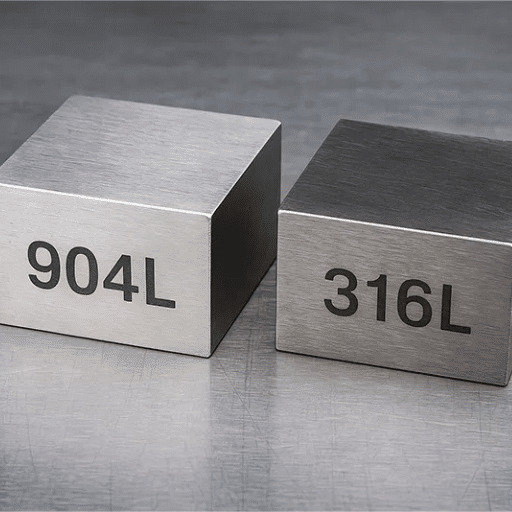
Nickel is roughly a quarter of the cost, with molybdenum and copper behind it, so the monthly movement above tracks LME nickel and molybdenum rather than demand. The seamless premium over welded runs about 8–10%, and that is the number to explain to a cost engineer. Third-party inspection (SGS, BV, TÜV) adds a surcharge in the 5–10% / US$0.40–0.70/kg band; U-bend forming and beveling are processing add-ons. The full form-by-form breakdown, including coil, plate, and bar, sits in our 904L price per kg analysis, and the comparison against a mainstream austenitic is in 904L vs 316L.
Verifying 904L Pipe on Receipt: PMI, Marking and MTR

Every competitor says “PMI and MTR available.” None tells you what to check.
PMI on Cu and Mo
904L is most often misrepresented on copper (1.0–2.0%) and molybdenum (4.0–5.0%), the two lines a substitute grade fails first. A 317L or SUS 890L substitution shows up as copper near zero. Spectro or PMI on the pipe body is the check, and it takes minutes.
Tomas, a QC inspector at a chemical plant in Antwerp, caught one in February 2026: incoming “904L” seamless pipe returned copper at 0.6% against the 1.0% minimum, and the heat was a 317L substitution. The pipe had a plausible-looking certificate. The PMI gun cost him ten minutes; the rejection avoided a mid-shutdown line replacement.
The Marking, the Certificate and the Dimensions
Three checks close the loop:
- Reconcile the marking against the test certificate. If the pipe is stencilled
NH, the MTR must state that it was not hydrostatically tested. If it saysETorUT, the certificate must record the NDT method. - Verify OD and wall against B36.19M for the nominal bore and schedule you ordered.
- Collect the documentation package, MTR, EN 10204 3.1 or 3.2, PMI report, and the Chinese product standard where applicable. Our material certificate procedure explains what each document should contain.
How to Write a 904L Pipe Purchase Order
Paste this clause list into your RFQ and leave nothing to interpretation:
- Grade: 904L / UNS N08904 / EN 1.4539 / S31782
- Governing standard: ASTM A312/A312M, grade TP904L (or EN 10216-5 / EN 10217-7 for PED scope)
- Form: seamless, welded, or welded-and-cold-drawn
- Size basis: NB, or OD × wall
- Schedule (for NB pipe)
- Length and length type: single random, double random, or cut length
- Quantity (pieces and total weight)
- End finish: plain, beveled to B16.25, or threaded
- Test basis: hydrostatic per A999, or NDT in lieu (ET per E426 / UT per E213)
- Marking including the
NH/ET/UTcode - Condition: solution annealed and pickled
- Certification: MTR, EN 10204 3.1 or 3.2, PMI
- Packing, marking and destination
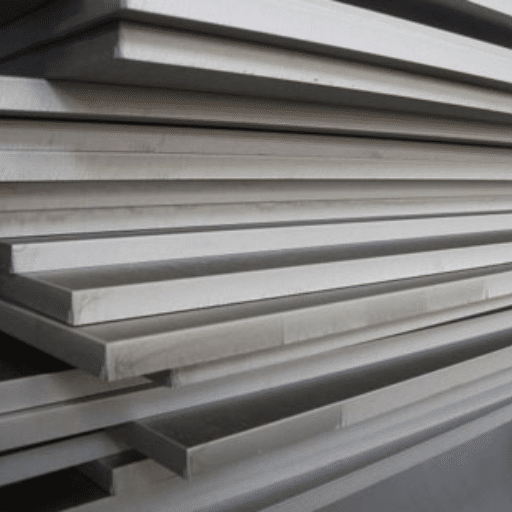
The plate version of this checklist is set out in our 904L stainless steel plate guide, and the same clause logic applies.
When 904L Pipe Is the Wrong Choice
Leading with the limits is the honest way to sell the grade. 904L pipe is not a warm-chloride or clean-seawater product: PREN 34–36 sits below the ≥ 40 convention applied to ambient seawater stainless, so warm or stagnant seawater service should go to 254 SMO or AL-6XN (the 6Mo comparison) or super duplex 2507. Hydrochloric acid is limited to roughly 1–2%, beyond which a nickel alloy is required; see nickel alloy pipe. Nitric acid service is worse than with a molybdenum-free grade, and service is capped near 400–450 °C, with sigma-phase concerns above about 550 °C. Establishing the grade’s limits is also what makes the rest of the page trustworthy, and the full application map shows where it does fit.
904L Pipe FAQ
Which ASTM standard covers 904L pipe, A312 or B677?
ASTM A312, grade TP904L. The B-series specifications currently cover UNS N08925, N08354 and UNS N08926: B677 is seamless pipe and tube, B673 is welded pipe, B674 is welded tube. N08904 appeared in superseded editions such as B677-99 and B677-04a. Verify the edition before it goes on a purchase order.
What is the difference between 904L pipe and 904L tube?
The size basis. Pipe is ordered by nominal bore to a fixed OD per ASME B36.19M and sized by schedule; tube is ordered by actual OD × wall and sized by gauge, to tighter tolerances under A213/A249/A269. A 2″ NB pipe has a 60.3 mm OD, so it is not a 2″ OD tube.
What sizes and schedules does 904L pipe come in?
Seamless runs roughly ½”–16″ NB, ERW welded ½”–24″ NB and EFW welded 6″–100″ NB, in schedules 5S, 10S, 40S and 80S per B36.19M, with non-S schedules to B36.10M. Stock is commonly SCH 10, 40, 80 and 160.
What does 904L pipe weigh per metre?
Derive it from the OD and wall: kg/m = (OD − WT) × WT × 0.02507, based on a density of 7.95–8.0 g/cm³. A 2″ NB SCH 40S pipe at 3.91 mm wall weighs about 5.53 kg/m; a 4″ NB SCH 40S pipe at 6.02 mm wall weighs about 16.3 kg/m.
Is 904L pipe seamless or welded, which should I specify?
Seamless for high-pressure, cyclic and small-bore service. Welded for large diameters and long lengths, with the seam pickled and passivated. Welded-and-cold-drawn, cold-reduced by at least 35% of wall before final anneal, sits between them at a lower cost than seamless.
How is 904L pipe tested, and what does the NH marking mean?
Hydrostatic testing per A999 (2800 psi [19.0 MPa] above 3.5 in. OD) is mandatory unless NDT is accepted in lieu. NH means not hydrostatically tested, ET means eddy-current tested, UT means ultrasonic tested.
What is the price of 904L pipe per kg?
FOB China in 2026, roughly US8.50–13.00/kg for seamless and US7.50–11.00/kg for welded, with a seamless premium of about 8–10%. Nickel, molybdenum and copper drive the monthly movement. See our 904L price-per-kg page for the full breakdown.
Can 904L pipe be welded, and can it be supplied as U-bend tube?
Yes to both. Welding uses ER385 filler, and no post-weld heat treatment is generally needed, though the seam needs pickling and passivation. U-bend tube is supplied in OD 12.7–38.1 mm with stress relief across the bend plus about 300 mm on each leg. Our 904L welding guide covers filler selection and procedure.
Conclusion
904L stainless steel pipe is a well-defined grade wrapped in a poorly-defined market. The five lines that carry the order are: cite ASTM A312 grade TP904L rather than the legacy B677; know whether you need pipe or tube, because a 2″ NB pipe is 60.3 mm OD; name the form, seamless, welded, or welded-and-cold-drawn; state the test basis and check the NH / ET / UT marking against the certificate; and verify copper and molybdenum by PMI on receipt. Get those five right and the pipe that arrives is the pipe your line was designed around.
Send your pipe or tube specification, form, size basis, schedule, length, end finish and test basis, and our team will confirm availability, certification and a quotation with MTR and PMI within 24 hours.
Request a certified 904L pipe quotation and put the five lines on the order sheet where they belong. For the rest of the grade, start with our 904L stainless steel overview or browse the full stainless steel range we supply.