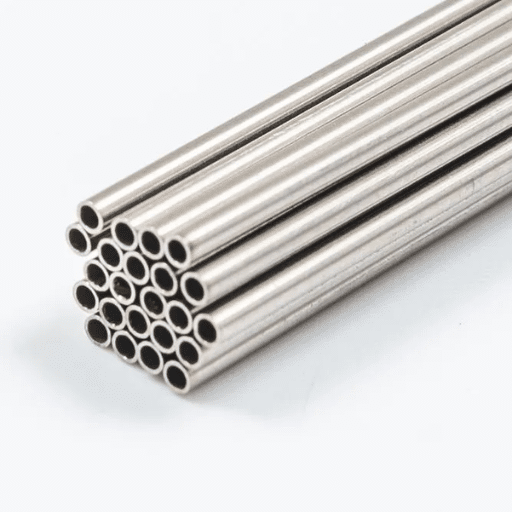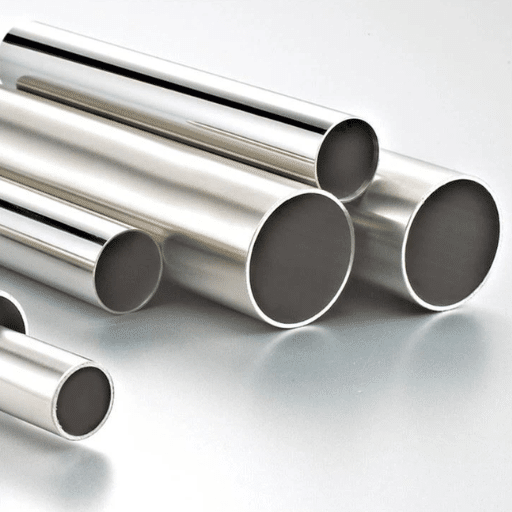
904L vs 2205 duplex is not a rank order: 904L (UNS N08904) and 2205 duplex (UNS S32205) are not interchangeable, even though both carry a pitting resistance equivalent number (PREN) of about 35. 2205 duplex is the strength-and-chloride grade: minimum yield is roughly double 904L’s and it costs about half as much per kilogram. 904L is the reducing-acid grade: its 1.0–2.0% copper resists sulfuric and phosphoric acid where a duplex microstructure cannot hold a passive film.
Somewhere in a project specification there is a line that reads “PREN ≥ 34, 904L or 2205 duplex acceptable.” Both grades satisfy it. Neither substitutes for the other. One of them costs roughly twice as much for the same duty, and on a large enough project that single sentence is the most expensive shortcut in the document.
The comparison is not the problem; every 904L vs 2205 duplex page compares the right properties. The problem is the model. The two grades are treated as rungs on a ladder, where the more expensive one must be the safer one. They’re two doors, not two floors.
This guide derives both PREN values on the page, names the four axes the index does not measure, corrects the industry’s wall-thickness shorthand with the ASME allowable-stress arithmetic, prices the 2026 multiple by product form, and is honest about the many chloride duties where 2205 is the better material and 904L is over-specification.
For the parent family, see our complete duplex stainless steel guide; for the austenitic side, the full 904L stainless steel guide.
Key Takeaways
- 904L vs 2205 duplex is a fork, not a ranking. Worked from mid-spec chemistry, 904L lands at PREN ~35.6 and 2205 at ~35.4, effectively equal, but they reach those numbers by completely different alloying routes.
- PREN has no term for copper. Copper is the element that carries 904L’s reducing-acid performance, so a matched PREN means the index has run out of resolution, not that the grades are equivalent.
- 2205 yields at ≥450 MPa against 904L’s ≥220 MPa, roughly double, and costs about 1.8–2.2× less by product form. The real wall-thickness saving is about 25%, not the 30–50% quoted across the market, once ASME Section II-D allowable stress is applied.
- In warm, creviced or flowing seawater both grades fail. Both held at 25 °C and both failed at 50 °C in chlorinated Arabian Gulf seawater, and both sit below the PREN ≥40 threshold for ambient seawater service.
- Where the threat is chlorides rather than acid, 2205 is both the better material and the cheaper one. We supply both grades and will tell you which side of the fork your duty sits on.
Direct Answer: Is 904L Better Than 2205 Duplex?

Neither grade is better. They answer different threats, and their corrosion indices are effectively equal at about PREN 35. 2205 duplex is the strength-and-chloride grade at the lower cost, while 904L is the reducing-acid grade. Choose by the failure mechanism you’re buying against, not by grade rank.
| Property | 904L (N08904) | 2205 duplex (S32205) |
|---|---|---|
| EN designation | 1.4539 | 1.4462 |
| GB/T designation | 015Cr21Ni26Mo5Cu2 (S31782) | 022Cr22Ni5Mo3N (S22053) |
| Microstructure | Austenitic, single phase | Duplex, roughly 50:50 austenite:ferrite |
| PREN, worked | ~35.6 | ~35.4 |
| Minimum yield, Rp0.2 | ≥220 MPa | ≥450 MPa |
| Minimum tensile, Rm | ≥490 MPa | ≥655 MPa |
| Continuous service ceiling | ~400 °C practical | ~300 °C |
| Magnetic | No | Yes |
| Relative cost | ~1.8–2.2× 2205 | 1.0 |
| Best-fit duty | Reducing acids, mixed acid-chloride, cryogenic, non-magnetic | Chloride and strength duty, sour service, thin-wall design |
The table is ordered so the PREN row sits directly above the yield row. Both grades read about 35. One of them yields at more than twice the other. If the index cannot see a difference that large, it is not the tool for this decision.
Not sure which side of the fork your duty sits on? Send the medium, concentration, temperature and chloride level, and our metallurgical team will confirm whether you have an acid problem or a chloride problem. Send your operating conditions
Two Grades, One PREN: Why the Index Cannot Choose For You
Deriving both numbers on the page
PREN = Cr + 3.3(Mo) + 16(N)
On mid-spec 904L (Cr 20, Mo 4.5, N 0.05): 20 + 3.3 × 4.5 + 16 × 0.05 = 35.6.
On mid-spec 2205 (Cr 22.5, Mo 3.1, N 0.17): 22.5 + 3.3 × 3.1 + 16 × 0.17 = 35.4.
Convention publishes 904L at about 34–36 and 2205 at about 33–35, and both ranges are legitimate. Published figures for 2205 reach as low as 32 and as high as 36 depending on where a given heat lands inside the specification.
That overlap is the point. It’s not a rounding artefact to be narrowed away. It’s the index telling you it has nothing left to say.
Different routes, and the routes are the whole story
2205 buys its PREN with nitrogen, weighted at 16 points per percent, and chromium. 904L buys its PREN with molybdenum, weighted at only 3.3 points per percent, and chromium.
That difference in alloying strategy is the visible part. The invisible part is this: 904L’s copper, the element that carries its performance in sulfuric and phosphoric acid, appears nowhere in the PREN formula. PREN was designed to rank pitting resistance in chloride environments, and it does that reasonably well for grades with similar microstructures. It was never meant to separate two grades from different material families whose performance is controlled by different elements. When it returns the same number for both, the correct conclusion is not “equivalent grades.” It is a “wrong index.”
The four axes PREN does not measure
| Axis | 904L | 2205 duplex | Who wins | Why the index is blind |
|---|---|---|---|---|
| Reducing-acid resistance | Usable 0–98% H₂SO₄ to ~40 °C | Low concentration, low temperature only (~≤10%) | 904L, decisively | No term for copper |
| Microstructure | Single-phase austenite | Two-phase, ~50% ferrite | Depends on the threat | No term for phase balance |
| Temperature ceiling | ~400 °C practical | ~300 °C continuous | 904L | Not a corrosion index |
| Allowable stress (ASME) | ~140 MPa | ~187 MPa | 2205 | Not a corrosion index |
Four decision-relevant variables, none of them represented. That is why a matched PREN is evidence of a screening failure, not of equivalence.
Chemical Composition: Where the Grades Actually Diverge
| Element | 2205 (S32205) | 904L (N08904) | What the delta buys |
|---|---|---|---|
| Chromium | 22.0–23.0% | 19.0–23.0% | Passive film stability; PREN |
| Nickel | 4.5–6.5% | 23.0–28.0% | Austenite stability and chloride SCC resistance; the largest cost swing |
| Molybdenum | 3.0–3.5% | 4.0–5.0% | Pitting and crevice resistance; PREN |
| Nitrogen | 0.14–0.20% | ≤0.10% | 2205’s strength and its PREN per unit of alloy |
| Copper | Not specified | 1.0–2.0% | Reducing-acid resistance; also MIC suppression in low-flow service |
| Carbon, max | 0.030% | 0.020% | Both low-carbon; neither sensitises in normal welding |
Nickel is the line to circle for cost. 904L carries 23–28% nickel against 2205’s 4.5–6.5%, and nickel plus molybdenum account for the majority of alloy cost in both grades. That single compositional gap is most of the price difference, and molybdenum volatility widens 904L’s premium faster than 2205’s.
Microstructure is the second composition
2205’s roughly 50:50 austenite-to-ferrite balance is a process parameter as much as a compositional one. It is set by thermomechanical treatment and by nitrogen; it must be verified on the finished product as a ferrite number of 30 to 70, and it is why welding 2205 is a procedure discipline rather than a consumable choice. Chinese designations appear on incoming mill certificates as 022Cr22Ni5Mo3N / S22053 for 2205 and 015Cr21Ni26Mo5Cu2 / S31782 for 904L, per GB/T 20878.
904L vs 2205 Duplex Mechanical Properties: Where 2205 Wins
| Property | 904L (ASTM B625) | 2205 duplex (ASTM A240) |
|---|---|---|
| Tensile strength, Rm | ≥490 MPa | ≥655 MPa |
| Yield strength, Rp0.2 | ≥220 MPa | ≥450 MPa |
| Elongation, min | ≥35% | ≥25% |
| Hardness | ~70–90 HRB | ≤293 HB / 31 HRC |
| Density | 7.95–8.00 g/cm³ | 7.81 g/cm³ |
| Thermal conductivity | ~12–13 W/m·K | ~15 W/m·K |
The hard number: 2205 yields at roughly twice 904L. That’s not a marginal advantage. It’s the difference between a grade that works in a pressure- or weight-driven design and one that doesn’t.
Two trades come with it. 2205 gives up ductility, about 25% elongation against 904L’s ≥35%, which matters for forming and impact toughness but not for pressure design. And 2205 runs roughly 25% higher thermal conductivity, which quietly favours duplex in heat-exchanger duty where the tube wall is the resistance. If 316L is your current baseline rather than 904L, the 904L vs 316L comparison sets the same arithmetic against the standard austenitic grade.
What the yield advantage is worth in wall thickness
This is where the market’s shorthand goes wrong. The claim repeated across supplier pages is that duplex saves 30–50% wall thickness. That figure is a yield-strength claim, not a code-allowable claim, and the two are not the same.
ASME Section II-D derives allowable stress as the lesser of Rm/3.5 and Rp0.2/1.5:
- 904L: min(490/3.5, 220/1.5) = min(140, 147) ≈ 140 MPa
- 2205: min(655/3.5, 450/1.5) = min(187, 300) ≈ 187 MPa
The ratio is 187/140, or 1.34×, not 2×. For 2205, the tensile rule governs, not the yield rule, and that caps the advantage. At 1.34×, the realistic thickness reduction is about 25%, not 30–50%. Read the allowable stress for your own design temperature from Section II-D rather than scaling from yield.
Kenji, a pressure-vessel fabricator in Osaka, priced a conversion using the “50% thinner wall” figure he had seen on three supplier sites. The re-price against Section II-D came back at roughly 25% thickness reduction. The vessel was still significantly cheaper in 2205, and the recommendation did not change, but his preliminary budget had been short by about a third on the shell weight.
The corrected arithmetic still points the same way. At about 25% less material and 1.8–2.2× the price per kilogram, 2205 costs roughly 2.5 to 3 times less per unit of pressure capability. The conclusion is unchanged. It now rests on a code number instead of a marketing line.
904L vs 2205 Duplex Corrosion Resistance: Two Different Threats

Reducing acids: 904L’s home ground
904L is usable across roughly 0–98% sulfuric acid to about 40 °C, and its real advantage sits in the 20–85% mid-concentration band. That is the gap 316L cannot cover and 2205 cannot cover either. The same copper chemistry carries phosphoric acid service, including wet-process acid with impurities, plus acetic and formic acid across their full ranges. 2205 in sulfuric acid is confined to low concentration at low temperature, commonly stated as ≤10% concentration; above that, the corrosion rate climbs quickly.
The mechanism matters, because it explains why this is a category difference rather than a degree difference. Duplex grades suffer selective corrosion in strong acid media because the micro-galvanic coupling between the ferrite and austenite phases impairs passivation.
In a tartaric plus sulfuric plus hydrochloric acid mixture at 40–60 °C, published work in Corrosion Science records 904L passivating and returning the lowest corrosion rates, while 2205 does not passivate at all. The duplex grade isn’t merely faster to corrode. It’s operating by a different mechanism.
One counter-intuitive result is worth carrying. In erosion-corrosion testing in 50 g/L sulfuric acid at 80–95 °C, the ranking from best to worst is 904L > 2507 > 2205 > 316L, with 904L recording the lowest mass loss even against super duplex (Wear, 2016). The caveat is that the ranking inverts toward the duplex grades at lower erosion intensity, so this is a finding about combined erosion and corrosion, not a general claim that 904L outlasts duplex everywhere. Our full 904L corrosion resistance guide carries the media-specific rate tables this article deliberately does not duplicate.
Chlorides: 2205’s home ground
2205 is effectively immune to chloride stress corrosion cracking to at least 150 °C, because the ferrite phase disrupts crack propagation through the austenite. 904L is resistant but not immune. It can crack under severe conditions such as boiling magnesium chloride, and cold-worked material carries higher residual-stress risk.
On pitting and crevice resistance, the two grades are broadly comparable, as AZoM’s family-level comparison records, so 2205’s chloride advantage is not a higher index. It’s strength, cost, and a wider stress corrosion cracking margin.
Working a chloride duty and being quoted 904L? If there’s no acid in the stream, you may be paying twice for corrosion protection you don’t need. Ask us to check the specification
The seawater test that humbles both
Chlorinated and unchlorinated Arabian Gulf seawater testing published in the Journal of Applied Electrochemistry (2001) returned a result that belongs on every seawater specification: both 904L and 2205 resisted at 25 °C and both failed at 50 °C. Higher-alloy grades held at every condition.
Both grades sit near PREN 35, below the PREN ≥40 threshold that NORSOK guidance applies to ambient seawater service. If your duty is warm, creviced or flowing seawater, neither grade is the answer. The correct move is super duplex 2507 or a 6Mo grade, covered in 904L vs 254 SMO.
Priya, a process engineer at a chemical plant on the Gulf Coast, inherited a brine cooling circuit specified in 904L. The service was chlorides only, no acid, at 45 °C, and the specification had been written by upgrading from 2205 after a pitting complaint rather than by diagnosing the cause. Moving to super duplex 2507 resolved the pitting. Staying on 904L would have roughly doubled material cost without addressing it, because the failure was a temperature and crevice problem, not an acid problem.
Sour service: a compliance question, not a preference
2205 is qualified under NACE MR0175 / ISO 15156-3 with a 32 HRC hardness cap. 904L is accepted in the solution-heat-treated condition with a 22 HRC general austenitic cap, and carries a 60 °C ceiling where elemental sulfur is present.
The practical rule is to run the sour check before the corrosion check, because a sour duty can remove one grade from consideration regardless of its corrosion data. Where elemental sulfur is present, 904L is a 60 °C material, and above that ceiling the answer is a nickel alloy such as Hastelloy C276 rather than either grade here.
Where 904L wins on the chloride side anyway
Three cases. Acid-contaminated or chlorinated cooling water is a mixed threat where 904L’s copper chemistry helps, as distinct from clean seawater. Low-flow, stagnant or intermittently wetted systems benefit from copper’s suppression of microbially influenced corrosion. And a non-magnetic requirement eliminates 2205 outright, because its ferrite content makes it magnetic and no specification change alters that.
Temperature Limits: The 300 °C Fork and the Cryogenic Floor
| Limit | 904L | 2205 duplex |
|---|---|---|
| ASME design values published to | 371 °C | Lower, with restrictions |
| Practical continuous service | ~400 °C | ~300 °C |
| Embrittlement onset | Sigma phase ~550 °C | Sigma/chi and 475 °C embrittlement above service ceiling |
| Cryogenic floor | Tough to ~−196 °C | Ductile-brittle transition ~−40 to −50 °C |
| Magnetic | No | Yes |
This is a hard fork in both directions. Above roughly 300 °C, the question is closed before corrosion is discussed: duplex is out, and 904L continues to about 400 °C. Below roughly −50 °C, the mirror image applies: duplex is out, and 904L continues to cryogenic service.
One honest boundary: above about 450 °C, neither grade is correct. That’s 316H, 310S, or high-temperature alloy territory, and buying 904L for it would be a mistake.
Welding 904L vs 2205: Opposite Fabrication Penalties
| Parameter | 2205 duplex | 904L |
|---|---|---|
| Matching filler | ER2209 wire / E2209-17 electrode | ER385 (AWS A5.9) |
| Never use | 308L, 316L or 309L filler | Standard 316L consumables |
| Solidification mode | Ferrite-austenite, tolerant | Fully austenitic, hot-cracking prone |
| Heat input | 0.5–2.5 kJ/mm | ≤1.5 kJ/mm, stringer beads |
| Interpass temperature | ≤150 °C, ≤100 °C thin sections | ≤100–150 °C |
| Purge gas | Argon + 1–2% N₂ | Argon |
| Post-weld heat treatment | Forbidden | Generally none; solution anneal 1090–1175 °C + water quench where specified |
| Verification | Ferrite number 30–70 FN | PMI on copper and molybdenum |
| Machinability | Work-hardens, ~20% lower cutting speed than 316L | Gummy, work-hardens rapidly |
The penalties point in opposite directions. 2205’s penalty is procedural discipline: phase balance must be controlled, and the weld must be verified by ferrite number, so welding labour runs high and an unqualified shop is a real risk. 904L’s penalty is solidification and heat input: a fully austenitic weld pool is crack-prone, so it wants clean consumables, low heat input, and stringer technique.
Neither grade is easy to weld relative to 316L, and both are harder than carbon steel. They fail in different ways, and the fix for one is not the fix for the other. On small fabrications, the filler premium plus procedure qualification can exceed the entire metal-cost difference between the grades.
904L vs 2205 Duplex Price: The 2026 Multiple by Form
The relative multiple, by form
China domestic mill comparison, August 2026:
| Form | 2205 (RMB/kg) | 904L (RMB/kg) | 904L multiple |
|---|---|---|---|
| Billet | ~28.9 | 64–68 | ~2.2–2.4× |
| Hot-rolled bar | 29.4–30.7 | 65–70 | ~2.2–2.4× |
| Wire | 30.3–32.6 | 65–70 | ~2.0–2.3× |
| Welded pipe | 34.8–35.0 | ~90 | ~2.6× |
At distributor level, 2205 plate runs about ¥30–50/kg against 904L at ¥70–110/kg, a multiple of roughly 2.0–2.2×. The headline range across the market is about 1.8–2.2× for most forms, widening to about 2.6× for welded pipe, and the escalation is form-driven rather than alloy-driven. For context against the grade most engineers know, 2205 runs about 1.2–1.5× 316L while 904L runs about 2–2.5× 316L. Our separately published 904L price-per-kilogram guide carries the full form-by-form 904L table and the cost-driver breakdown; this article gives the relative multiple only.
What the multiple is buying, and the payback condition
The premium buys exactly one thing that cannot be substituted: copper-mediated reducing-acid resistance. Where the duty is a reducing acid, the multiple isn’t a markup; it’s the only route. Where the duty is chloride-only, the multiple buys nothing. 2205 is both the better material and the cheaper one, and 904L is over-specification.
On the crossover arithmetic, 2205’s roughly 25% thickness saving combined with its 1.8–2.2× per-kilogram advantage yields about 2.5 to 3 times lower cost per unit of pressure capability. That’s why the strength-driven branch of the decision is rarely close. Prices move with nickel and molybdenum, so treat published figures as 7- to 14-day indications and route final numbers to a live quotation.
When to Choose 904L vs 2205: Decision Framework
Choose 2205 duplex when
- The threat is chlorides, not acid: seawater, brine, chlorinated cooling water, sour service
- Strength, pressure rating, or weight drives the design
- Service sits below ~300 °C and above ~−50 °C
- Magnetic properties are acceptable or required
If the specification says 904L for a chloride duty, check whether the acid case is actually present. Where it is not, 2205 is the correct grade and roughly half the material cost.
Choose 904L when
- The controlling threat is a reducing acid: sulfuric acid in the 20–85% band, wet-process phosphoric acid, organic acids, or mixed acid-chloride streams
- Service sits above ~300 °C and below ~400 °C
- Service sits below ~−50 °C
- Non-magnetic behaviour is required
- The system runs at low flow or wets intermittently, where copper suppresses microbiologically influenced corrosion
- Elemental sulfur is absent and the sour check passes
Choose neither when
- Warm, creviced or flowing seawater: use super duplex 2507 or a 6Mo grade at PREN ≥40, because both grades here failed at 50 °C in chlorinated Gulf seawater
- Hot concentrated sulfuric acid above about 40% with chlorides present: Alloy 20 territory
- Hydrochloric acid above about 1–2%: Hastelloy B3 or C276
- Above about 450 °C: 316H, 310S or a high-temperature alloy
| Operating condition | Recommended grade |
|---|---|
| Chloride duty, strength-driven, below 300 °C | 2205 duplex |
| Reducing acid (H₂SO₄ 20–85%, wet-process H₃PO₄) | 904L |
| Mixed acid plus chloride, 40–60 °C | 904L |
| Sour service with elemental sulfur above 60 °C | Nickel alloy, not either grade |
| Warm or creviced seawater | 2507 or a 6Mo grade |
| Non-magnetic requirement | 904L |
| Above 300 °C and below 400 °C | 904L |
For the equipment-level map covering desalination, flue gas desulfurization and hot-acid service, see 904L applications by industry.
Sourcing Both Grades from China: Documentation That Proves the Grade

A 904L vs 2205 duplex decision is only as good as the material that arrives. Both grades are routinely substituted, and each fails differently.
For 904L, specify PMI on the copper (1.0–2.0%) and molybdenum (4.0–5.0%) lines specifically. Copper is both the acid mechanism and the element a substitution most obviously degrades, so a heat low on copper is 904L in name only. Specify the solution-annealed and water-quenched condition.
For 2205, verify the ferrite number (30–70 FN) and read the PREN from the actual ladle analysis. A 2205 heat that lands low on nitrogen or molybdenum loses both strength and pitting resistance, and neither loss is visible on a nameplate.
By product form, the applicable standards are ASTM A240, A790, A789, A276/A479 and A182 for 2205, against ASTM B625, B677, B673/B674, A312/A358 and A479/B649 for 904L. Both grades ship from Wuxi and Jiangsu suppliers, and both can be sourced on a single purchase order. Ask for the mill test report (MTR) alongside EN 10204 3.1 certificates for routine supply, 3.2 where the project requires independent witness, and a NACE MR0175 / ISO 15156-3 compliance statement for sour service.
904L vs 2205 Duplex FAQ
Is 904L better than 2205 duplex?
Neither is better. They answer different threats, and their corrosion indices are effectively equal, both near PREN 35. 2205 is the strength-and-chloride grade at lower cost; 904L is the reducing-acid grade. Choose by the failure mechanism you are buying against, not by grade rank.
Which is stronger, 904L or 2205 duplex?
2205, decisively. Minimum yield is ≥450 MPa against 904L’s ≥220 MPa, roughly double, with tensile ≥655 against ≥490 MPa. The trade is ductility: 2205 gives about 25% elongation against 904L’s ≥35%, which matters for forming rather than for pressure design.
Is 904L more expensive than 2205 duplex?
Yes, by roughly 1.8–2.2× for most product forms on the 2026 China mill comparison, widening to about 2.6× for welded pipe. The premium is almost entirely nickel, since 904L carries 23–28% against 2205’s 4.5–6.5%.
Can 904L replace 2205 duplex?
Only where the controlling threat is a reducing acid. For chloride service, 904L costs roughly twice as much and offers no corrosion advantage, because 2205 resists chloride pitting comparably and resists chloride stress corrosion cracking far better. Substituting upward on a chloride duty is over-specification.
Is 2205 duplex magnetic? Is 904L magnetic?
2205 is magnetic because its microstructure contains roughly 50% ferrite. 904L is fully austenitic and non-magnetic as annealed, with relative permeability about 1.002. Where non-magnetic behaviour is a hard requirement, 2205 cannot be specified at any price.
Which resists sulfuric acid better, 904L or 2205?
904L, by a wide margin. 904L is usable across 0–98% sulfuric acid to about 40 °C, with its real advantage in the 20–85% mid-concentration band. 2205 is confined to low concentration at low temperature, commonly stated as ≤10%, because duplex suffers selective corrosion in strong acid.
What is the maximum service temperature for 2205 duplex?
Continuous service should not exceed about 300 °C. Above that, sigma and chi phase precipitation causes embrittlement. 904L holds to about 400 °C practical service, with ASME design values published to 371 °C, so hot acid duty belongs to the austenitic grade.
Can 904L and 2205 duplex be welded together?
Dissimilar joints between them use a nickel-based filler such as ERNiCrMo-3. Matching-base-metal welds use ER385 for 904L and ER2209 for 2205, never 316L filler. Both need controlled heat input, and post-weld heat treatment is forbidden for the duplex side.
Does 904L cost twice as much as 2205?
Roughly, for most forms, about 1.8–2.2× on the 2026 China mill comparison. But 2205’s higher allowable stress permits about 25% less wall thickness for the same pressure rating, so the gap per unit of pressure capability widens to roughly 2.5–3×.
Which is better for seawater, 904L or 2205 duplex?
Neither, for warm or creviced seawater. Both resisted at 25 °C in chlorinated Arabian Gulf seawater, and both failed at 50 °C, and both sit near PREN 35, below the ≥40 threshold used for ambient seawater service. Super duplex 2507 or a 6Mo grade is the correct answer.
Conclusion
A matched PREN means the index has run out of resolution, not that the grades are equivalent. 904L vs 2205 duplex is a fork between two material families that happen to share a corrosion number, and that number cannot see the copper which decides 904L’s acid performance or the ferrite which decides 2205’s chloride and strength behaviour.
Three numbers carry the decision. PREN, about 35.6 for 904L against 35.4 for 2205. Yield, ≥220 MPa against ≥450 MPa. And the cost multiple, about 1.8–2.2× for one substitution that cannot be bought any other way, but which buys nothing at all on a chloride-only duty.
Tell us your medium, concentration, temperature, chloride level, and whether the design is pressure- or weight-driven. We will confirm whether the duty is a chloride problem, an acid problem, or neither, and quote both grades from the same heat lot with MTR, PMI, and EN 10204 3.1 documentation. Quotation within 24 hours.