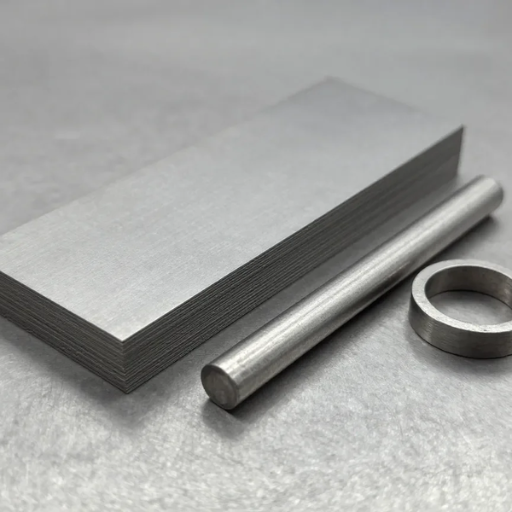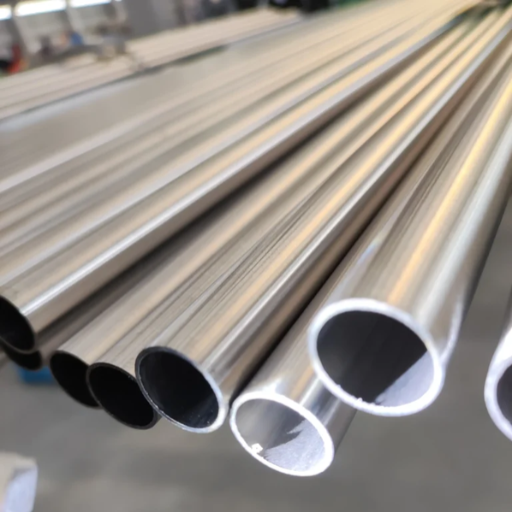
Inconel 600 pipe is a nickel-chromium-iron pipe made to UNS N06600 (Werkstoff 2.4816). It’s ordered against ASTM B167 for seamless product, B163 for condenser and heat exchanger tube, or B516 and B517 for welded tube and welded pipe. In 2026 it trades at roughly 25to25to45 per kilogram for standard mill forms, which puts a metre of 2-inch Schedule 40 at about 150to150to180 before freight and duty.
The material isn’t the hard part of the purchase. The hard part is that “Inconel 600 pipe” describes an alloy, not a product. It says nothing about whether you need pipe or tube, which of four ASTM specifications applies, what the wall thickness is, what test was run, or what the pipe may carry at temperature.
Consider Dana, a piping engineer at a Rotterdam chemical plant who sent out an inquiry for “Inconel 600 pipe, 2 inch, ASTM B167” in early 2026. Two of the four quotes came back as heat exchanger tube: 2-inch outside diameter, 1.65 mm wall, twenty-foot lengths. The plant needed 2-inch nominal pipe size, Schedule 40, 3.91 mm wall, and piping that would bolt to a standard flange. Every quote was technically ASTM B167, and none of them was the same product.
That gap between an alloy name and a purchase description is where money is lost. This guide closes it. You’ll get the standards map, the dimension system, weight per metre at alloy density, the load and oxidation limits, and the corrosion conditions that decide acceptance. It also covers the heat-treatment sequence for pipe and the 2026 price arithmetic including US duty.
Need a specific size and specification priced? Send the nominal size, schedule or wall, specification, test requirements and quantity, and our sales team will confirm availability and quote against the current mill position. Request an Inconel 600 pipe or tube quote.
Key Takeaways
- Inconel 600 pipe is ordered to one of four ASTM specifications: B167 (seamless pipe and tube), B163 (seamless condenser and heat exchanger tube), B516 (welded tube) or B517 (welded pipe). Naming the alloy alone is not a specification.
- Pipe is dimensioned by nominal pipe size and schedule under ASME B36.10M; tube is dimensioned by outside diameter and wall. A 2-inch pipe is 60.3 mm OD with a 3.91 mm wall at Schedule 40; a 2-inch tube is 50.8 mm OD.
- Alloy 600 weighs 8.47 g/cm3, about 7.9% more than carbon steel, so a Schedule 40 2-inch pipe is 5.87 kg/m rather than 5.44 kg/m.
- The 1,095°C figure in every datasheet is the top of the application range, and oxidation is demonstrated at 980°C. Neither is a load rating. Allowable stress lives in ASME Section II Part D.
- High-temperature, high-strength caustic service requires full stress relief at 900°C for 1 hour or 790°C for 4 hours before use. Nickel alloy pipe entering the US from China under HTS 7507.12.00.00 carries a 39.5% total effective duty.
What Is Inconel 600 Pipe?
Inconel 600 is a solid-solution nickel-chromium-iron alloy that is hardened only by cold work. The Special Metals SMC-027 bulletin gives the limiting composition in Table 1. Nickel plus cobalt runs 72.0% minimum, chromium 14.0% to 17.0% and iron 6.00% to 10.00%. The residuals are tight: carbon 0.15% max, manganese 1.00% max, sulfur 0.015% max, silicon 0.50% max, and copper 0.50% max.
That composition is why pipe buyers choose it. The high nickel gives resistance to many organic and inorganic compounds and makes the alloy, in the bulletin’s words, “virtually immune to chloride-ion stress-corrosion cracking.” The chromium provides resistance to sulfur compounds at moderate temperatures and to oxidizing conditions at high temperatures.
Composition that matters to a pipe buyer
Three elements drive the purchase decision and the price.
Nickel is the corrosion base and the largest cost item. It is also the element behind the chloride stress-corrosion claim, and the claim depends on staying above the 72% minimum.
Chromium is the oxidation element. It forms the protective oxide that lets the pipe survive furnace and heat-treating atmospheres, and it is the reason 600 is specified for retorts, muffles and radiant service.
Carbon is the element that creates the fabrication trap. At 0.15% maximum, it is deliberately kept in the alloy, and it precipitates as chromium carbide between 540°C and 760°C. That precipitation is what makes the annealing and cooling sequence in the heat-treatment section matter.
There is no deliberate molybdenum or niobium. That single fact separates 600 from 625 and 718. It is also why 600 is the least expensive grade in the Inconel family, and why it gives up pitting and crevice resistance in chloride-rich water.
Which service range the bulletin actually supports
SMC-027 states that the alloy’s versatility has led to use “in a variety of applications involving temperatures from cryogenic to above 2000°F (1095°C).” That is the application range, not a rating for any single part.
Two numbers sit inside that range and are routinely confused with each other.
The first is 1,095°C (2,000°F), the top of the range. Above it the alloy still resists oxidation but carries almost no useful load, and you can see that in the bulletin’s high-temperature tensile curves, which fall steeply past 800°C.
The second is 980°C (1,800°F), where Figure 11 of the bulletin reports cyclic oxidation testing with 15 minutes of heating and 5 minutes of cooling in air. That figure describes the alloy’s ability to keep a protective oxide under thermal cycling. It is a test condition, not a pressure rating.
If your pipe has to hold pressure at 900°C, neither number answers your question. The answer is in ASME Section II Part D, and the section below explains how to use it.
Inconel 600 Pipe Standards: B167, B163, B516 and B517 Explained
Four ASTM product specifications cover Inconel 600 pipe and tube, and the differences between them are structural, not cosmetic. The scope language below is quoted from the ASTM store pages, which are public.
| Specification | Form | Service intended | Scope language |
|---|---|---|---|
| ASTM B167 | Seamless pipe and tube | General corrosion-resistant and heat-resistant | Cold-worked annealed, hot-worked annealed and hot-finished seamless pipe and tube |
| ASTM B163 | Seamless tube | Condenser and heat exchanger | Seamless tubes for condenser and heat-exchanger service, ordered by OD and average wall or OD and minimum wall |
| ASTM B516 | Welded tube | Boiler, heat exchanger and condenser | Welded from flat-rolled alloy by automatic welding, no filler metal |
| ASTM B517 | Welded pipe | General corrosive and heat-resisting | Welded, cold-worked and annealed pipe, ordered by outside diameter and nominal wall |
Seamless pipe and tube: ASTM B167
B167 is the specification most buyers mean when they say “Inconel 600 pipe.” Its scope covers nickel-chromium-iron alloys, including UNS N06600 in three conditions: cold-worked annealed, hot-worked annealed and hot-finished.
The scope also tells you what the specification will test. B167 requires chemical analysis, a tension test, and then either a hydrostatic test or a nondestructive electric test. That “or” is a purchase-order decision, not a detail. If your project specification, your insurance inspector or your end user expects a hydrostatic hold, B167 does not force the mill to run one, and the pipe can arrive with an eddy-current test instead.
Write the test you want into the order. Do not assume the standard supplies it.
Heat exchanger and condenser tube: ASTM B163
B163 covers seamless tube for condenser and heat exchanger service. The scope is explicit about the dimension basis: outside diameter and average wall, or outside diameter and minimum wall.
That distinction matters more than it looks. An average-wall order permits the wall to run below nominal as long as the average across the circumference holds. A minimum-wall order does not. A tube that has to survive a tube-sheet expansion and a corrosive shell side is usually ordered minimum wall, and the two orders are not interchangeable at the same price.
B163 is a tube specification. If a quote for “600 pipe” cites B163, you are being offered tube, and the dimensions will be OD-based.
Welded tube and welded pipe: B516 and B517
B516 is welded tube and B517 is welded pipe. Both are made from flat-rolled alloy by automatic welding with no filler metal, then cold-worked and annealed.
The distinction between them is the same distinction that runs through this whole article. B516 tube is ordered for boiler, heat exchanger and condenser service. B517 pipe is ordered for general corrosive service and heat-resisting applications, by outside diameter and nominal wall, against the referenced ASTM and ANSI dimension documents.
A supplier who lists “ASTM B167 / B163 / B516 / B517” as a single line is telling you that it stocks or sources all four. It is not telling you which one you are buying.
The general-requirements companions: B751, B775, B829
Three specifications carry the general requirements that the product specifications call up: tolerances, marking, retest procedure, rounding and packaging.
ASTM B829 is the general-requirements document for seamless pipe and tube, and its requirements are mandatory for B163 and B167 among others. ASTM B751 does the same job for welded tube and names B516. ASTM B775 does it for welded pipe and names B517.
You rarely order to these directly. You cite them when a tolerance dispute arises, because they are where the permitted wall variation, length tolerance and straightness limits actually live.
What the specification requires you to test
Across the four product specifications, the test menu is consistent: chemical analysis, tension test, and a pressure or electric test.
What varies is what you can add. Flattening, reverse bend, flare, hardness, grain size, intergranular corrosion and ultrasonic examination are all orderable, and none of them arrive unless the order says so.
This is where a specification sheet earns its keep. Consider two order descriptions. The first reads “Inconel 600 pipe, ASTM B167.” The second reads “Inconel 600 pipe, ASTM B167, hydrostatic tested, 100% eddy current to ASTM E426, mill test report to EN 10204 3.1, ultrasonic wall check.” They are the same alloy and two different products.
Sizes, Schedules and Weight Per Metre
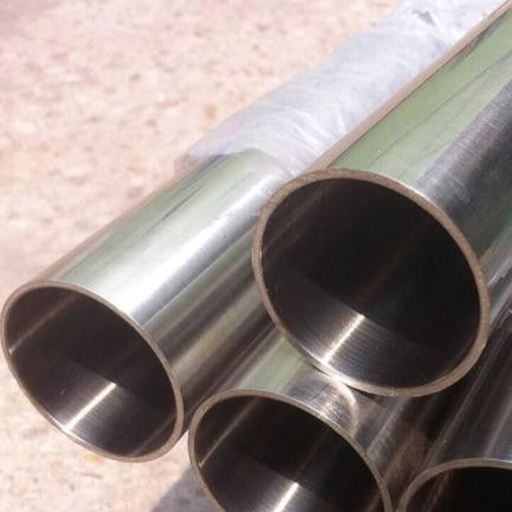
Pipe and tube use two different dimension systems, and mixing them is the most common ordering error in this alloy.
Pipe is dimensioned by NPS and schedule; tube by OD and wall
Pipe is described by nominal pipe size, which is a label rather than a measurement, and by schedule, which sets the wall. The outside diameter for each nominal size is fixed by the ASME B36.10M wrought pipe dimension standard. The schedule then selects the wall from a table that is identical for every alloy.
This is the single most useful fact for a 600 buyer: schedule numbers are dimensional, not material-dependent. A Schedule 40 2-inch pipe has a 3.91 mm wall whether it is carbon steel, 316 stainless steel or Inconel 600. The alloy changes the weight and the allowable stress, not the size.
| NPS | Nominal | OD (mm) | Sch 40 wall (mm) | Sch 80 wall (mm) |
|---|---|---|---|---|
| 1/2 | DN 15 | 21.3 | 2.77 | 3.73 |
| 3/4 | DN 20 | 26.7 | 2.87 | 3.91 |
| 1 | DN 25 | 33.4 | 3.38 | 4.55 |
| 1-1/2 | DN 40 | 48.3 | 3.68 | 5.08 |
| 2 | DN 50 | 60.3 | 3.91 | 5.54 |
| 3 | DN 80 | 88.9 | 5.49 | 7.62 |
| 4 | DN 100 | 114.3 | 6.02 | 8.56 |
| 6 | DN 150 | 168.3 | 7.11 | 10.97 |
Tube is described differently. A tube order names the outside diameter and the wall directly, so “25.4 mm OD × 2.11 mm wall” is a complete description with no schedule involved.
The two will not connect. A 2-inch nominal pipe is 60.3 mm OD, and a 2-inch tube is 50.8 mm OD.
Weight per metre at 8.47 g/cm3
Weight per metre follows from the annulus area and the alloy density:
W (kg/m) = π × (OD − t) × t × 8.47 / 1000, with OD and t in millimetres.
Alloy 600 at 8.47 g/cm3 is 7.9% denser than carbon steel at 7.85 g/cm3, so every published carbon-steel weight must be scaled up. The table below gives both, with the carbon-steel column converted from the published lb/ft values on the B36.10 chart.
| NPS | Schedule | OD (mm) | Wall (mm) | Alloy 600 (kg/m) | Carbon steel (kg/m) | Alloy 600 (lb/ft) |
|---|---|---|---|---|---|---|
| 1/2 | 40 | 21.3 | 2.77 | 1.37 | 1.27 | 0.92 |
| 1 | 40 | 33.4 | 3.38 | 2.70 | 2.50 | 1.81 |
| 2 | 40 | 60.3 | 3.91 | 5.87 | 5.44 | 3.94 |
| 2 | 80 | 60.3 | 5.54 | 8.07 | 7.48 | 5.42 |
| 3 | 40 | 88.9 | 5.49 | 12.18 | 11.29 | 8.19 |
| 4 | 40 | 114.3 | 6.02 | 17.35 | 16.08 | 11.66 |
| 6 | 40 | 168.3 | 7.11 | 30.50 | 28.26 | 20.49 |
| 6 | 80 | 168.3 | 10.97 | 45.93 | 42.56 | 30.86 |
Three uses follow from this table. First, freight: a 6-metre length of 6-inch Schedule 40 weighs 183 kg in 600 against 170 kg in carbon steel, and air freight quotes will notice. Second, price: a /kgquotebecomesa/kgquotebecomesa/m number only after you multiply by the correct weight. Third, structural: pipe supports sized against a steel weight estimate will be about 8% light.
What a supplier’s size range does and does not tell you
Most 600 pipe pages publish a range like “4 to 219 mm outside diameter, wall 0.5 to 20 mm” or a schedule list running from SCH 5 to XXS. Those lines describe what the supplier will quote, not what it holds.
Two questions close the gap. Ask for the wall thickness in millimetres for the exact nominal size and schedule, and ask whether the offer is pipe dimensions or tube dimensions. A supplier that answers both in one sentence has a real product behind the page.
Seamless or Welded Inconel 600 Pipe?
The choice is made by specification, service and inspection, in that order.
What each specification covers
Seamless pipe to B167 has no weld seam, so there is no weld metal, no heat-affected zone and no weld inspection question. It is made by piercing and rolling or by extrusion, then cold-drawn or hot-finished to size.
Welded pipe to B517 is made from strip, formed and welded without filler metal, then cold-worked and annealed. Welded tube to B516 is the same construction with tube dimensions and boiler or heat exchanger service intended.
The metallurgical difference is smaller than the marketing suggests. Alloy 600 welds readily, and the bulletin states that it is “readily joined by conventional welding processes.” A properly annealed weld in 600 is a sound joint.
Which one to order
Order seamless when the specification, the purchaser or the inspector requires it, and when the service is pressure-containing at temperature with a longitudinal stress you cannot easily inspect. Inconel 600 seamless pipe to B167 is the default for general corrosion and heat-resistant piping, and it is the specification most project standards name.
Order welded when the size or the cost demands it. Welded pipe is made in larger diameters and thinner walls more economically, and B517 exists precisely for general corrosive service where the seam can be inspected.
Order neither until you have written down the test. A hydrostatic test on a welded pipe finds a through-wall defect. An eddy-current test finds a wall discontinuity. A project that needs both should say both, because B167 and B517 let the mill choose otherwise.
Comparing welded and seamless offers? Send both quotes with their test scope and our engineers will flag what differs before you place the order. Talk to our pipe team.
Pressure, Temperature and the Load Limit
A pipe is a pressure part, and the number that governs Inconel 600 pipe is the allowable stress at design temperature.
Allowable stress lives in ASME Section II Part D
SMC-027 states that Inconel 600 is approved under the ASME Boiler and Pressure Vessel Code. The approvals cover Section I for power boilers, Section III for nuclear vessels, and Section VIII for pressure vessels, with allowable design stresses found in Section II Part D. Section I coverage is provided by Code Case 1827.
That is the pointer, and it is the only defensible answer to “what pressure will it hold.” The allowable stress values are tabulated in Section II Part D and are not reproduced here. That document is a purchased code, and this page has not read it.
What you can do without the code is understand the shape of the answer. Allowable stress falls as temperature rises, and once creep begins to govern, it is rupture data rather than tensile strength that sets the number. The bulletin’s creep table begins at 800°F (427°C), which is the first temperature at which it publishes creep data for the alloy.
Creep and rupture from SMC-027
The bulletin publishes the data you would use to build a design curve. Table 20 gives the stress for a secondary creep rate of 0.01% and 0.1% per 1,000 hours, for cold-drawn, annealed, and solution-treated material. Table 21 gives the stress to produce rupture at 10, 100, 1,000, 10,000 and 100,000 hours.
Both tables are reproduced as typical data, not design allowables. The standard practice is to apply a design factor to the rupture value. In the creep range, the governing case is usually the 100,000-hour rupture value at design temperature with that factor applied, or the code’s tabulated allowable stress, whichever the jurisdiction accepts.
This is where a 600 pipe specification should cite the code, not a datasheet. A datasheet gives you a tensile strength at 871°C. The code tells you what fraction of it you may use.
The 1,100°C number is oxidation, not strength
Nearly every 600 pipe page carries the claim that the alloy “retains strength up to 1,100°C” or “works up to 2,000°F.” Two different things are being conflated.
The application range in SMC-027 runs to above 1,095°C. Oxidation resistance is demonstrated at 980°C under cyclic conditions. The high-temperature tensile curves in the same bulletin show the alloy retaining meaningful strength at 760°C and very little above 900°C.
The engineering reading is straightforward. Above about 900°C, specify 600 for oxidation resistance, thermal cycling and structural support of its own weight, and expect almost nothing in the way of pressure capability. A furnace muffle at 1,000°C is a normal 600 application. A pressure pipe at 1,000°C is not.
Corrosion Service Conditions That Decide the Order
Five service conditions decide whether a 600 pipe is accepted or rejected, and they are all documented in the mill bulletin.
| Service condition | What SMC-027 documents | What the order has to carry |
|---|---|---|
| Chloride in aqueous service | Virtually immune to chloride-ion SCC at 72% minimum nickel | Standard annealed supply is adequate |
| High-temperature, high-strength caustic | Subject to SCC; stress relief mandatory before use | Full stress relief at 900°C/1 h or 790°C/4 h, certified |
| Mercury at elevated temperature | SCC may occur; use the caustic recommendations | Same stress relief, plus assembly review |
| High-temperature sulfur-bearing atmosphere | Resists sulfur at moderate temperature; subject to sulfidation when hot | Service review; sulfur-free assembly lubricant above 427°C |
| Strongly oxidizing acids | Fair resistance; air-saturated mineral acids can attack | Corrosion test, or move to 625 |
Chloride SCC: the 72% nickel claim, correctly stated
SMC-027 states that the alloy, at a 72% minimum nickel content, is “virtually immune to chloride-ion stress-corrosion cracking.” It gives the mechanism as well. The tendency of austenitic alloys to crack transgranularly in chloride solutions falls as nickel content rises.
That is a strong claim and it is well supported. It is also narrower than the way it is usually repeated.
The immunity is to chloride cracking in aqueous service. It is not immunity to stress-corrosion cracking in general. The same page of the bulletin says the alloy is subject to stress-corrosion cracking in high-temperature, high-strength caustic alkalies, and that cracking may also occur in the presence of mercury at elevated temperature.
Some supplier pages take the chloride claim and turn it into “susceptible in high-chloride environments,” which is the reverse of what the bulletin says. Others take the caustic warning and generalise it into a marine suitability claim.
Both are wrong. Chloride service in water is the alloy’s strength. Hot concentrated caustic is its documented weakness.
Caustic service and the mandatory stress relief
This is the most important paragraph on the page for anyone buying 600 pipe into a chemical plant.
SMC-027 states that 600 is subject to stress-corrosion cracking in high-temperature, high-strength caustic alkalies. It then sets the condition: material for such service “should be fully stress-relieved at 1650°F/1 hr or 1450°F/4 hr (900°C/1 hr or 790°C/4 hr) before use, and operating stresses should be kept to a minimum.”
Read “before use” carefully. It is not a post-weld treatment to be decided on site. It is a condition of the material before it enters service, and it applies to the pipe as supplied.
Of the 37 ranking pages analysed for this topic, one mentions stress relief at all, and none gives the cycle. This is the single most valuable fact missing from the competitive set.
In practice, that means the purchase order for caustic service carries the stress relief as a line item with the cycle, and the mill certificate states that it was performed. A pipe supplied annealed but not stress-relieved to the caustic cycle has not met the bulletin’s recommendation, whatever its tensile test says.
The Inconel 600 heat treatment guide covers the cycle selection and the cooling requirement in detail.
Sulfidation, and the MoS2 rule
Alloy 600 resists attack by sulfur compounds at moderate temperatures. SMC-027 is equally explicit that it “is subject to sulfidation in high-temperature, sulfur-containing environments.”
Several ranking pages present 600 as a furnace material without that caveat. In a sulfur-bearing furnace atmosphere above moderate temperature, the chromium oxide film is compromised and the alloy sulfidises. Reducing atmospheres with sulfur are the worst case.
The bulletin adds a fabrication rule that catches people in assembly. Molybdenum disulfide, a lubricant sometimes used to aid parts assembly, “should not be used if the material will be subsequently exposed to temperatures above 800°F (427°C).” At that point a pipe thread or a flange bolt lubricated with MoS2 paste becomes a sulfur source inside the joint.
Use a sulfur-free anti-seize for 600 pipe that will run hot, and write it into the assembly procedure.
Oxidizing acids: what “fair” means
SMC-027 reports “fair resistance to strongly oxidizing acid solutions.” It also warns that dissolved air alone will not protect the alloy against air-saturated mineral acids and some strong organic acids.
That is a moderate statement, and it is the honest one. Many 600 pages claim strong resistance to sulfuric, hydrochloric and nitric acids. The bulletin does not support that, and a buyer who specifies against it will eventually find out in a corrosion test.
If your service is a mineral acid, ask two questions before specifying 600: is the acid aerated, and is there a chloride present that would make 625 the better choice? The Inconel 600 vs 625 comparison works through that decision.
Inconel 600 Pipe in Nuclear and Heat Exchanger Service
Steam generator tubing was the largest single application of alloy 600 tube in the world, and its history is the most useful cautionary case in the alloy’s record.
Why steam generator tubing moved to Alloy 690
SMC-027 calls 600 “a standard material of construction for nuclear reactors” and reports “excellent resistance to corrosion by high-purity water”. It also describes the tighter-specification 600T grade for nuclear work.
The operating record is more complicated. The US Nuclear Regulatory Commission’s steam generator fact sheet states that some steam generator tubes, mostly mill-annealed Alloy 600, cracked from a combination of stress and corrosion. A small percentage of thermally treated 600 tubes also cracked. Replacement steam generators built after 1989 have primarily used thermally treated Alloy 690, and the majority of US pressurised water reactors now run 690 tubing.
The lesson is specific to the application, not to the alloy. In high-purity water at temperature, under residual stress and with a corroding crevice at the tube sheet, 600 was marginal in the mill-annealed condition and the industry moved to a higher-chromium alloy.
What that means for a non-nuclear buyer
Three practical conclusions follow.
First, if you are buying 600 tube for a heat exchanger in high-purity water service, do not specify mill annealed by default. The thermally treated condition exists for a reason, and the heat treatment guide covers the cycle.
Second, the nuclear history is not a reason to avoid 600 in chemical, furnace or general heat exchanger service. Those applications are documented in the bulletin and they are not the ones that failed.
Third, anyone who tells you 600 is the standard nuclear steam generator material today is working from a 1980s datasheet. It was, and then it was not.
For a heat exchanger in a corrosive shell side rather than pure water, the selection logic is different and usually favours 625 or 690. The Inconel 600 applications guide sets out which service conditions each alloy carries, and the Inconel 625 pipe page covers the molybdenum-bearing alternative.
Fabrication and Heat Treatment for Pipe
Pipe is heat treated twice: once at the mill, and once more if you weld it.
Annealing and the 540-760°C carbide window
SMC-027 gives the mill anneal as about 1,850°F for 15 minutes (1,010°C for 15 minutes), which produces soft material. A brief exposure to 1,040°C also softens the alloy without coarsening the grain, and grain growth does not begin until about 980°C.
The trap is the cooling curve. Between 1,000°F and 1,400°F (540°C and 760°C) chromium carbides precipitate at the grain boundaries. The bulletin says the alloy “should be rapidly cooled through that range if the material is to be pickled or used in an environment requiring freedom from sensitization.”
A slow cool through that window produces a sensitised microstructure. The pipe passes its room-temperature tensile test and fails an intergranular corrosion test, or performs badly in service.
For welded pipe, the same rule applies to the weld heat-affected zone. A fabricator who heat-treats a welded 600 spool at 620°C for stress relief has parked the metal in the middle of the precipitation window. The Inconel 600 welding guide makes that point at length.
If a stress relief is genuinely required for the service, the temperature has to be chosen with that window in mind. The caustic cycle at 900°C or 790°C sits above or at the top of it for a reason.
Pickling, passivation and cleanliness
The bulletin is direct about heating. Alloy 600 “must be clean before it is heated and must be heated in a sulfur-free atmosphere.” Furnace atmospheres for forging or open annealing should be slightly reducing to prevent excessive oxidation.
Bright annealing is only possible in very dry hydrogen or in a vacuum. Otherwise the pipe must be pickled if a bright surface is required. A normal mill supply is annealed and pickled, sometimes described as AP finish.
The practical consequence for a pipe buyer is that contamination control starts at the mill and continues on site. Sulfur-bearing marking crayons, chloride-bearing degreasers and carbon-steel tooling all leave a residue that will show up as a corrosion site.
Welding note
Three filler combinations are named in the bulletin. INCONEL Welding Electrode 182 for shielded metal arc welding. INCONEL Filler Metal 82 for gas tungsten arc and gas metal arc welding. Filler Metal 82 with INCOFLUX 4 for submerged arc.
It also gives a warning that affects pipe welds specifically: welds made with electrode 182 may have decreased ductility after extended exposure to 1,000°F to 1,400°F (540°C to 760°C). A 600 pipe spool welded with 182 and then run in that band is a different proposition from one welded with 82.
Inconel 600 Pipe Price in 2026
Price for this alloy is quoted per kilogram and needs to be converted to a per-metre number before you can compare anything.
Per kilogram, per metre, per foot
The published 2026 asking range for standard mill forms of Inconel 600 is 25to25to45 per kilogram. Tube sits in the lower part of that band, at 26to26to30 per kilogram in the 2026 supplier guides tracked in our Inconel 600 price per kg guide. Heavy-wall or specially tested pipe runs above it.
Multiplying by the weight per metre from the earlier table gives a material cost per metre.
| NPS and schedule | Weight (kg/m) | At $26/kg | At $30/kg |
|---|---|---|---|
| 1 inch Sch 40 | 2.70 | $70.20/m | $81.00/m |
| 2 inch Sch 40 | 5.87 | $152.62/m | $176.10/m |
| 2 inch Sch 80 | 8.07 | $209.82/m | $242.10/m |
| 3 inch Sch 40 | 12.18 | $316.68/m | $365.40/m |
| 4 inch Sch 40 | 17.35 | $451.10/m | $520.50/m |
| 6 inch Sch 40 | 30.50 | $793.00/m | $915.00/m |
To convert to price per foot, divide by 3.28084. A 2-inch Schedule 40 at 30/kgis30/kgis176.10 per metre, or $53.68 per foot.
The per-metre numbers are material only. They exclude cutting, bevelling, threading, testing beyond the standard menu, packing, freight and duty.
What moves the number
Five variables account for most of the spread between two quotes for the same line.
Condition and finish comes first. A hot-finished annealed and pickled pipe is the base case. A cold-drawn, bright-annealed or ground pipe costs more because each step adds yield loss.
Test scope comes second. A hydrostatic test is cheap. A 100% eddy-current test to ASTM E426 with a written report is not, and an ultrasonic wall-thickness scan with a full record adds again.
Certification comes third. A mill test report is included. An EN 10204 3.2 certificate, which requires a third-party inspector to witness the tests, adds roughly 10% to 30% on the figures collected for the price guide. AMS release adds more.
Quantity and random lengths come fourth. A tonne lot of random-length pipe is the cheapest form. Cut-to-length, small quantities and exact multiples of a spool length all carry a premium.
Origin comes fifth, and for a US buyer it is the largest single variable after the alloy itself.
US duty on nickel alloy pipe from China
Nickel alloy pipe and tube classifies under HTS 7507.12.00.00. According to the current US tariff lookup, that line carries a 2% most-favoured-nation rate, plus 12.5% under heading 9903.05.31 and plus 25% under Section 301 heading 9903.88.03 for goods of China. The total effective rate is 39.5%.
Do not confuse that with the 75% figure that circulates for Inconel 600. The 75% applies to hot-rolled stainless steel bar under HTS 7222.11.00.06. Nickel alloy pipe is a different chapter and a different rate.
At 39.5%, a 2-inch Schedule 40 pipe quoted at 176.10permetreFOBcarries176.10permetreFOBcarries69.56 per metre of duty, for a landed material cost near $245.66 per metre before freight. That arithmetic alone explains most of the gap between a mill quote and a US service-centre quote.
Working to a landed-cost target? Send the size, schedule, specification, quantity and destination port, and we will quote the pipe with the test and certificate scope itemised separately.
How to Specify and Order Inconel 600 Pipe
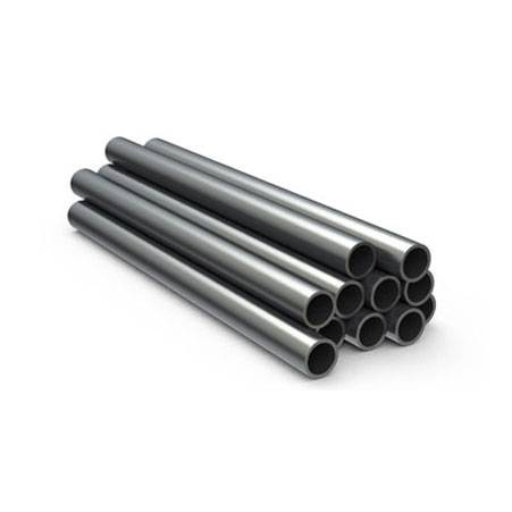
A complete order line for this alloy has ten parts. Anything missing becomes an assumption, and assumptions are where the quote variance comes from.
A ten-line order description
- Alloy and UNS number. Inconel 600, UNS N06600, Werkstoff 2.4816.
- Product form. Seamless pipe, welded pipe, or tube.
- Specification. ASTM B167 for seamless pipe and tube, B517 for welded pipe, B516 for welded tube, B163 for condenser and heat exchanger tube.
- Dimensions. Nominal size and schedule with the wall in millimetres for pipe, or OD and wall in millimetres for tube.
- Length. Random, double random, or cut to a stated length with a tolerance.
- Condition and finish. Hot-finished annealed and pickled, cold-drawn annealed, bright annealed, or stress-relieved to a stated cycle.
- Test requirements. Hydrostatic or nondestructive electric as a minimum, plus any added eddy current, ultrasonic, hardness, grain size or intergranular corrosion test.
- Certification. Mill test report, EN 10204 3.1 or 3.2.
- Marking and packaging. Standard specification marking, plus any project marking and end protection.
- Quantity and delivery term. Metres or pieces, Incoterm, destination and required date.
Certification: EN 10204 3.1, 3.2 and what a mill certificate proves
A mill test report is a declaration by the manufacturer that the material meets the specification, with the actual test results for the heat.
An EN 10204 3.1 certificate is issued by the manufacturer’s independent inspection department. An EN 10204 3.2 certificate is issued by an inspector who is independent of both the manufacturer and the purchaser, and who witnessed the tests.
The difference is who signs. For most chemical and petrochemical work, 3.1 is the normal requirement. For nuclear, offshore and some project specifications, 3.2 is mandatory, and it must be ordered at the time of purchase because the witness has to be present during the test.
What a certificate does not prove is that the test you needed was run. A 3.1 certificate for a heat that was eddy-current tested and not hydrostatically tested is a complete and honest document, and it will not satisfy an inspector who expected a hydrostatic hold. The certificate follows the order, so the order has to be right.
The material certificate guide explains the document types and what each one commits the issuer to.
Inspection and test plan
For critical service, attach an inspection and test plan to the order. A workable one for 600 pipe covers five checks.
First, chemical analysis against Table 1 of the specification and tensile properties against the same document. Second, dimension and wall verification. Third, surface condition and pickling.
Fourth, the pressure or electric test. Fifth, any supplementary test the service requires.
Add the stress-relief cycle to the plan if the service is caustic. Add a hardness check if the pipe will be welded and the fabricator needs to confirm the condition. Add an intergranular corrosion test if the service is oxidizing and the pipe has been heat treated after forming.
Questions to ask any supplier
Four questions separate a supplier with product from a supplier with a page.
Ask which of the four specifications the offer is made against, and whether the dimensions are pipe dimensions or tube dimensions. Ask for the wall thickness in millimetres for the exact schedule. Ask what test was run, and whether it was hydrostatic or electric. Ask whether the stress relief for caustic service can be supplied and certified.
A supplier that answers all four precisely is one you can order from.
Frequently Asked Questions
Are alloy 600 and Inconel 600 the same?
Yes. Inconel 600 is the Special Metals trade name for the alloy designated UNS N06600 and Werkstoff 2.4816. European and Chinese supply often uses the generic “alloy 600” or the designations GH3600 and NS3102. An inquiry for alloy 600 pipe and an inquiry for Inconel 600 pipe reach the same material, and the composition limits are the same across all of them.
What is Inconel 600 pipe used for?
The mill bulletin names four service families. In chemical processing it lists heaters, stills, bubble towers, condensers for fatty acids and evaporator tubes for sodium sulfide. In heat treating it lists furnace components such as retorts, muffles and roller hearths. It also names nitriding containers and nuclear reactor components.
Pipe and tube specifically appear as heat exchanger and condenser tube, furnace radiant tube and process piping.
What is the cost of Inconel 600 per kilogram?
Published 2026 supplier guides put standard mill forms at 25to25to45 per kilogram, with tube at the lower end, around 26to26to30 per kilogram. A 2-inch Schedule 40 pipe weighs 5.87 kg per metre, which puts material cost at roughly 153to153to176 per metre before freight and duty.
What is the difference between Inconel 600 pipe and Inconel 600 tube?
Pipe is dimensioned by nominal pipe size and schedule, and is ordered under ASTM B167 or B517. Tube is dimensioned by outside diameter and wall, and is ordered under ASTM B163, B516 or B167. A 2-inch pipe has a 60.3 mm outside diameter. A 2-inch tube has a 50.8 mm outside diameter.
Can Inconel 600 pipe be used in caustic service?
Yes, with a condition. The mill bulletin states that high-temperature, high-strength caustic service requires the material to be fully stress-relieved at 900°C for 1 hour or 790°C for 4 hours before use, with operating stresses kept to a minimum. Without that treatment the alloy is subject to stress-corrosion cracking in that service.
What temperature can Inconel 600 pipe withstand?
The bulletin’s application range runs from cryogenic to above 1,095°C, and oxidation resistance is demonstrated under cyclic exposure at 980°C. Neither figure is a pressure rating. For pressure service, the allowable stress at design temperature comes from ASME Section II Part D. The bulletin’s own creep and rupture tables start at 427°C, which is where that code check starts to control the wall.
Is Inconel 600 pipe resistant to seawater?
No claim of seawater resistance should be made. The bulletin documents resistance to chloride-ion stress-corrosion cracking in aqueous service, which is not the same as resistance to pitting and crevice corrosion in seawater. The alloy contains no molybdenum for pitting resistance. For seawater and chloride-rich water, an alloy with molybdenum such as 625 is the usual choice.
The Pipe Is a Specification, Not an Alloy Name
Inconel 600 pipe is a well-documented alloy whose purchase goes wrong in predictable places. The four checks below are the ones that fail.
The specification comes first. B167 for seamless pipe and tube, B163 for condenser and heat exchanger tube, B516 for welded tube, B517 for welded pipe, with B751, B775 and B829 supplying the general requirements. A quote that names only the alloy has not named a product.
The dimensions come second. NPS and schedule under B36.10M for pipe, OD and wall for tube, and a weight per metre computed at 8.47 g/cm3 rather than copied from a carbon-steel chart.
The service conditions come third, and they are where the real engineering sits. Chloride SCC is the alloy’s strength. Hot caustic is its documented weakness and it requires a specific stress relief before use. High-temperature sulfur is a limitation, and a molybdenum disulfide assembly lubricant is a sulfur source.
The load limit comes fourth. The 1,095°C and 980°C numbers describe oxidation, not pressure. Allowable stress is in the code.
Get those four right and 600 pipe performs exactly as the bulletin says it will. That means furnace service, heat exchangers, and chemical piping where chloride cracking is the failure mode you’re designing against. Get them wrong and the failure mode is one the datasheet never mentioned.
Ready to specify? Send the size, schedule or wall, the ASTM specification, the test scope and the quantity. Our team will confirm the dimensions, the test and the certificate you need, and answer with a quote that itemises them.
Jiangsu Zhonggongte Metallurgical Technology Co., Ltd. runs hot and cold rolling tube lines, vacuum induction and electroslag remelting furnaces, and heat treatment furnaces in Wuxi. Spectral testing and material certificates are part of the service. Request an Inconel 600 pipe quote or read more about our mill.