A $2.4 million failure started with the wrong hardness specification.
Being the year of 2022, the Ohio producer of valves bought a whole batch of 410 stainless steel bars, all of which have been tested to show a stiffness reading of 96 HRB; at least those bars would have on them in writing from the order given, “Type 410 in accordance with ASTM A276.” No one made it clear whether the material was meant to undergo annealing for machining or hardening for service. The machine shop guy got it with annealed-in the service. He then bored the seats, threaded the bodies, and shipped the valves. Three months later, the initial valve failed in a high-pressure steam line. The material had never even been heat-treated. It was soft enough that it would stretch under load, whereas it should have been 22-45 HRC.
The hardness of stainless steel varies depending on at least three grade, condition, and test method parameters. It is this extreme difference that engineers and buying teams often overlook, which can result in a host of catastrophic failures, rejected shipments, and unnecessary machining costs. This is an informative text geared to helping pinpoint and control hardness so as to certify such stainless steel to live up to benchmarks.
What Is the Hardness of Stainless Steel?
The hardness of stainless steel is its resistance to local plastic deformation, measured by how well it resists indentation, scratching, or wear. Depending on the grade and condition, stainless steel can range from approximately 70 HRB for soft annealed austenitic grades to over 58 HRC for hardened martensitic grades like 440C.
Hardness Defined
In metallurgical terms, hardness reflects a material’s ability to resist permanent shape change when force is applied locally. It is closely related to tensile strength. In many steels, a higher hardness reading correlates directly with higher ultimate tensile strength and yield strength. But hardness also affects machinability, formability, and wear resistance.
For procurement managers, hardness is a quality gate. For machinists, it is a tooling decision. For design engineers, it is a performance limit. All three groups need to speak the same language, which starts with understanding the testing scales.
Why Hardness Matters in Industrial Applications
Hardness drives three production and service results:
- Wear resistance: In an abrasive environment, grades with greater hardness will last longer. Bearings, valves, and cutting edges require higher hardness.
- Structural load capacity: Greater hardness generally means greater strength, and hence thinner or smaller working sections.
- Fabrication constraints: Hardness determines whether a grade can be cold worked, machined conventionally, or without post-heat treatment welding.
In this manner, hardness may be one of the most essential characteristics to specify properly on a purchase order, rather than as an afterthought. Rather, it would be a design input.
How to Measure the Hardness of Stainless Steel
There is no single “best” way to measure hardness. The right method depends on the material condition, the component geometry, and the precision required.
Rockwell Hardness (HRB and HRC)
The Rockwell test represents the most common penetration hardness test within the North American industry. It is used to measure the difference in depth made by successive indentation at two loads, one after the other.
- Rockwell B (HRB): A 1/16-inch steel ball with a 100 kgf load, most commonly used on softer annealed austenitic and ferritic stainless steels. Regular range is from 70 to 95 HRB for the likes of 304, 316, and 430 classes of material.
- Rockwell C (HRC): Hard materials are measured by a diamond cone with a 150 kgf load. This includes all martensitic grades after heat treatment, duplex grades, and precipitation-hardening grades. HRC may fall within a range of 20–62 HRC.
Note that annealed austenitic grades are too soft for meaningful HRC readings. If your supplier indicates that HRC of annealed 304 is 86, the test method is almost surely wrong.
Brinell Hardness (HB / HBW)
Brinell testing involves a 10 mm diameter steel ball or hardened tungsten carbide ball pressed against the surface at a load of 3,000 kgf. An operator measures the diameter of the resultant impression and determines the hardness number.
Brinell is particularly well suited for castings, forgings, and large cross-sections for which the material is not at all uniform. The larger test allows for more averaging of local variations than the small Rockwell indentation does. However, the Brinell is less suitable for very thin sheets or small parts.
Vickers Hardness (HV)
The Vickers test employs a diamond pyramid with a 136-degree indenter sharp on both ends. The operator measures the diagonals of the indentation at the microscope and calculates the hardness value.
The Vickers method is very versatile, as it can be applied to almost all materials – from very soft (response-annealed stainless) to very hard, completely hardened tool steels. It is the fit choice for thin plates, welds, surface coatings, and tiny precision components. Since the indenter always remains the same geometry, the Vickers scale acts as a continuous scale without switching arbitrarily from Rockwell B to C or other scales.
Which Test to Specify
When drafting a purchase order or material specification, match the test method to the application:
- HRB for soft grades in bulk form (sheet, plate, bar in annealed condition)
- HRC for heat-treated components, duplex grades, and wear parts
- HV for thin sections, welds, research-grade precision, and surface hardness mapping
- HB / HBW for castings, forgings, and thick structural sections
If the project follows ASTM standards, reference ASTM E18 for Rockwell, ASTM E10 for Brinell, and ASTM E92 or E384 for Vickers.
Need help selecting the right hardness test for your specification? [Contact our metallurgical team] for ASTM-compliant testing guidance.
Hardness of Stainless Steel by Grade and Family
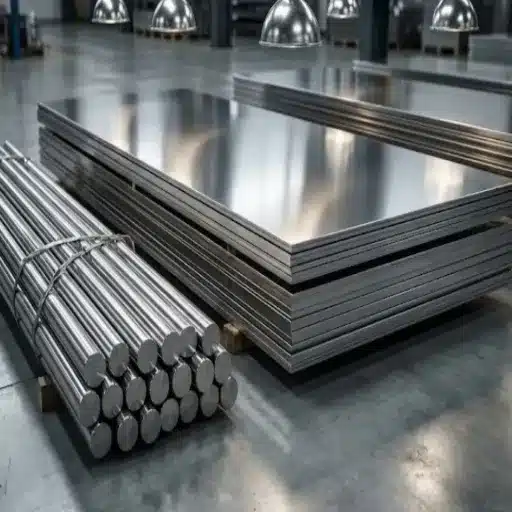
Stainless steel families are defined by microstructure, and microstructure is the primary driver of hardness capability.
Austenitic Grades (304, 316)
Grades 304 and 316 are the warriors of the stainless steel world. These are soft with great ductility when in the annealed condition.
- 304 annealed: ~70–92 HRB / 123–201 HBW max
- 316 annealed: ~79–95 HRB / 123–217 HBW max
There is no hardening of an austenitic grade through heat treatment. Increased hardness can only be achieved through cold working-rolling, drawing, or bending. Heavy cold-working of 304 can harden up to almost HRC 35–40, but in return can compromise ductility and magnetism.
Ferritic Grades (430, 439)
Ferritic stainless steels are alloys having no nickel or only minimal nickel. Being that, they are also magnetic and typically cheaper compared with the austenitic range.
- 430 annealed: ~80–89 HRB / 170–183 HB
Unlike austenitics, ferritics cannot be heat-treated to harden. Their rate of strain hardening is not as high as it is with austenitics and actually makes them softer, often easier to machine.
Martensitic Grades (410, 420, 440C)
Martensitic stainless steels are the most common family, which is drastically hardened by the heat treatment process. It also provides an application for wear resistance.
- 410 annealed: ~96 HRB / 217 HB; hardened: HRC 22–45
- 420 annealed: ~96 HRB / 217–248 HB; hardened: HRC 50–54
- 440C annealed: ~29 HRC / 269 HB; hardened: 58–62 HRC
440C is the hardest of the most common stainless steel grades. It is used in ball bearings, valve seats, high-end cutlery, and in precision wearing components where maximum hardness is required.
Duplex Grades (2205, 2507)
Duplex stainless steels merge two phases, ferritic and austenitic, on a microstructural level. They offer excellent mechanical properties and corrosion resistance without subsequent heat treatment.
- 2205: ~31 HRC / 293 HB
- 2507: ~28–32 HRC / 277–302 HB
These are much higher than the annealed 316. In practice, 2205 gives about double the yield strength of 316L, thereby permitting thinner walls in pressure vessels and piping.
Precipitation Hardening Grades (17-4PH, 15-5)
Precipitation hardening (PH) stainless steels accumulate high power through the oldest heat treatment instead of the traditional quench and temper. They offer a distinct combination of high hardness and average corrosion resistance similar to 304.
- 17-4PH: up to ~37–44 HRC depending on aging condition (H900, H925, H1025, H1075, H1100, H1150)
- 15-5: similar range with somewhat better toughness than 17-4PH
Stainless Steel Hardness Chart
This table summarizes typical hardness values by grade and family. Actual values may vary slightly depending on the producer, heat lot, and exact specification.
| Grade | Family | HB (Typical) | HRB (Typical) | HRC (Typical) | Hardening Method |
|---|---|---|---|---|---|
| 304 | Austenitic | 123–201 | 70–92 | — | Cold working |
| 316 | Austenitic | 123–217 | 79–95 | — | Cold working |
| 430 | Ferritic | 170–190 | 80–89 | — | Limited cold working |
| 410 | Martensitic | 217 | 96 | 22–45 | Heat treatment |
| 420 | Martensitic | 217–248 | 96 | 50–54 | Heat treatment |
| 440C | Martensitic | 269–285 | — | 58–62 | Heat treatment |
| 2205 | Duplex | 293 | — | 31 | As-delivered |
| 2507 | Duplex | 277–302 | — | 28–32 | As-delivered |
| 17-4PH | PH | 353+ | — | 37–44 | Aging heat treatment |
Hardness Conversion Chart
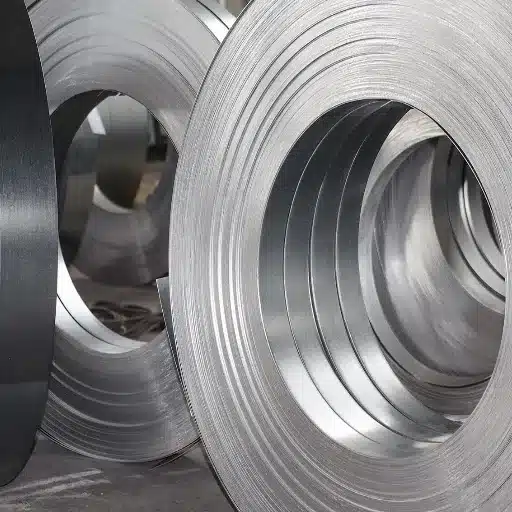
Because no exact mathematical formula converts between all hardness scales, engineers use standardized conversion tables. The following condensed chart covers the ranges most commonly encountered in stainless steels.
| Brinell (HB) | Vickers (HV) | Rockwell C (HRC) | Rockwell B (HRB) |
|---|---|---|---|
| 444 | 474 | 47 | — |
| 388 | 410 | 42 | — |
| 341 | 360 | 36.5 | — |
| 321 | 339 | 34.5 | 108 |
| 302 | 319 | 32 | 107 |
| 293 | 309 | 31 | 106 |
| 285 | 301 | 30 | 105 |
| 277 | 292 | 29 | 104 |
| 248 | 261 | 24 | 101 |
| 241 | 253 | 23 | 100 |
| 235 | 247 | 22 | 99 |
| 229 | 241 | 20.5 | 98 |
| 223 | 235 | — | 97 |
| 217 | 228 | — | 96 |
| 212 | 222 | — | 95 |
| 207 | 218 | — | 95 |
| 201 | 212 | — | 94 |
| 197 | 208 | — | 93 |
| 192 | 202 | — | 92 |
| 187 | 197 | — | 91 |
| 183 | 192 | — | 90 |
| 179 | 188 | — | 89 |
| 174 | 182 | — | 88 |
| 170 | 179 | — | 87 |
| 163 | 171 | — | 85 |
| 156 | 163 | — | 83 |
| 149 | 156 | — | 81 |
| 143 | 150 | — | 79 |
| 137 | 144 | — | 76 |
| 131 | 138 | — | 74 |
Important: There is no reliable direct conversion between HRB and HRC in the soft range where annealed austenitic stainless steels fall. That is why 304 and 316 are rarely quoted in HRC.
How Hardness Affects Machinability and Processing
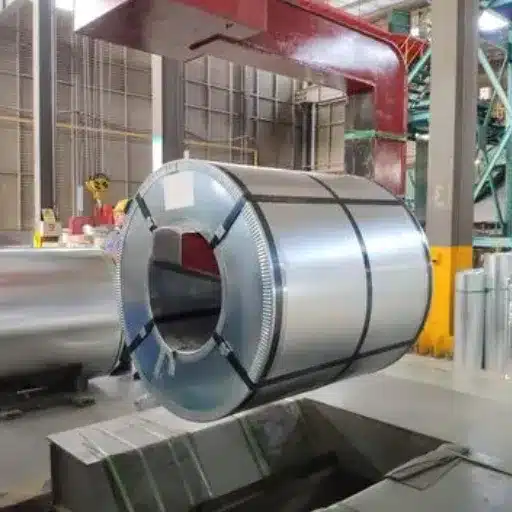
Hardness is not just a material property. It is a manufacturing constraint.
Work Hardening in Austenitic Grades
Grade 304 and 316 go through severe hardening, which is why they go hard pretty fast. Since the tool’s metal shearing happens, the area becomes harder. When the tool does dwell or rub instead of cutting clean, the toughened surface layer gradually causes rapid wear to tools and may then go on to cause the insert to break suddenly due to catastrophic reasons.
The answer is high-but-consistent feed rates, sharp positive-rake carbide inserts, and high-pressure coolant. When machinability is desired above all else, 303 (a sulfurized lightweight variant of 304) machines even more easily but with a slight decrease in corrosion resistance.
Machining Martensitic Grades
The hardness of martensite grades completely depends on their condition. In the annealed state, 410 and 420 workpieces successfully undergo relatively easy machining. In their hardened state, they become so abrasive that one needs to perform grinding or hard milling with ceramic or diamond-coated tools.
Smart shops always perform rough machining in an annealed condition, then on to the final heat treatment and grinding only in the critical surfaces. Tooling costs and cycle time are drastically reduced.
Duplex Machining Challenges
Duplex 2205 is more rigid and resilient than 316, meaning it translates into higher cutting forces and more heat generation. Standard 316 tooling parameters will simply not work. The applications necessitate rigid setups, positive-rake carbide inserts, and a generous flow of coolant.
During 2023, a machining operation for precision in Hamburg switched from using 316L to 2205 with a seawater pump housing, without having to reset speeds and feeds. The effect is a tool life shortened by 60%, 25% increased cycle times, along with a below-specification surface finish quality. However, they found better process results from using grade-specific duplex inserts and pushing the coolant pressure up. The market offers a direct lesson: hardness and strength define tool strategy.
Specifying and Verifying Hardness in Procurement
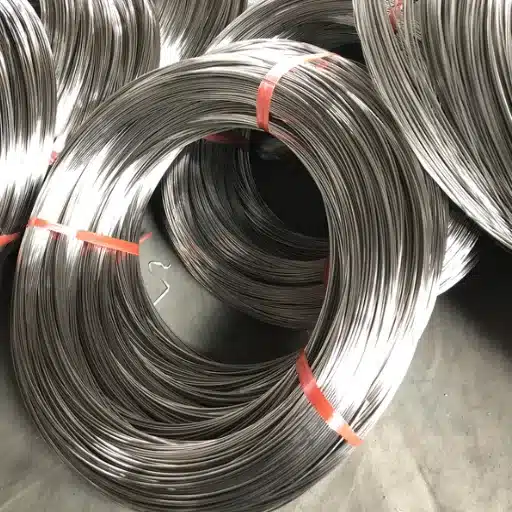
For critical projects, hardness should be specified clearly on the purchase order and verified on delivery.
What to Include in Your Purchase Order
A hardness specification has four parts:
- Grade and Condition: Type 410, annealed for machining, or 440 C, hardened to 58 to 60 HRC.
- Test Method: HRB, HRC, HV, or HB / HBW as per ASTM, ISO, or EN standard.
- Acceptable Hardness Range: 95 HRB max, or 37 to 44 HRC as examples.
- Test Location: Surface, Through Thickness, or Specific Zone (e.g., weld HAZ).
If these are missing, vendors may fall back on the softest and cheapest condition or may choose a test method that is not compliant with your QA requirements.
Reading the Mill Test Report (MTR)
The Mill Test Report (MTR) is a fundamental document that provides certification for the properties of the material. Hardness figures often appear in the mechanical properties section, along with tensile strength, yield strength, and elongation.
When reading an MTR, verify three things:
- The test method matches your specification (e.g., HRB, not HRC, for annealed 304)
- The reported value falls within your acceptable range
- The sample location and orientation are appropriate for your component geometry
Common QA Pitfalls
Even experienced buyers make errors during hardness verification:
- Testing the wrong surface condition: The surface can be scaled or decarburized, which can cause readings to be read as softer than in the bulk metal.
- Confusing scales: HRC quoted for annealed austenitic steel grades technically has to be thought about it as it seems a bit removed from any reality.
- Sampling errors: Giving an unrepresentative reading can result from testing too close to an edge or a weld.
A 2025 MDPI study published in Applied Sciences presents a setup-in-progress where researchers utilized CNNs to classify the hardness of cold-rolled AISI 304 samples trained on magnetic field maps. Around 95 to 100% accuracy in typifying the class of material hardness with CNNs makes it an exciting end-to-end, validating scenario. The largest lowering in hardness during annealing occurs at about 1000°C. Although this neural-network approach is not yet widespread in industry QA, this points to the future where remote hardness checking becomes easy and usual.
Conclusion
While in terms there is a bit of set definition or hardness, this is something one will find quite variable, which will totally rely upon metallurgical family, processing condition, and the test method. There is a considerable ambiguity on this grade that rates 70 HRB in one situation, and then again, it may top the scale 60 HRC or better any other day. The crucial secret that separates an excellent specification from one that costs an error is in the knowledge of this relationship.
By choosing 304 for formability, 440C for maximum resistance to wear, or 2205 for high-strength corrosion service, the right hardness specification ensures that the material will perform as expected. Also, it significantly reduces the risk while keeping projects on a timely schedule. Translate all this into clear purchase orders, verified MTR data, and comprehensive material testing to meet all the fail-safes essential in safeguarding time and other resources in an operation.
From this perspective, when a project comes that needs stainless steel with guaranteed hardness and absolute documentation, we can provide you with this one. We supply certified materials following ASTM, EN, and ISO standards, offering hardness testing and traceability.
Request a quote today and get the exact grade, condition, and hardness specification your application demands.