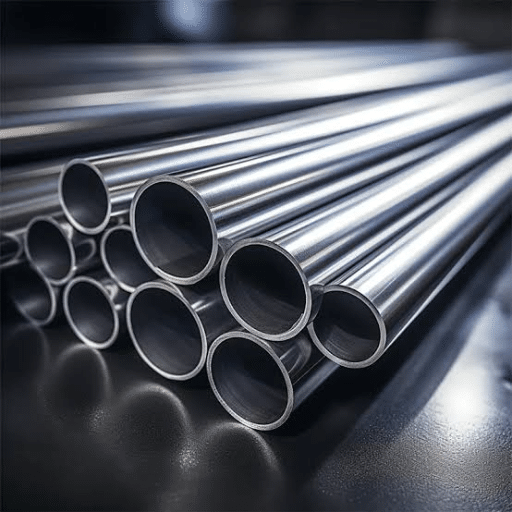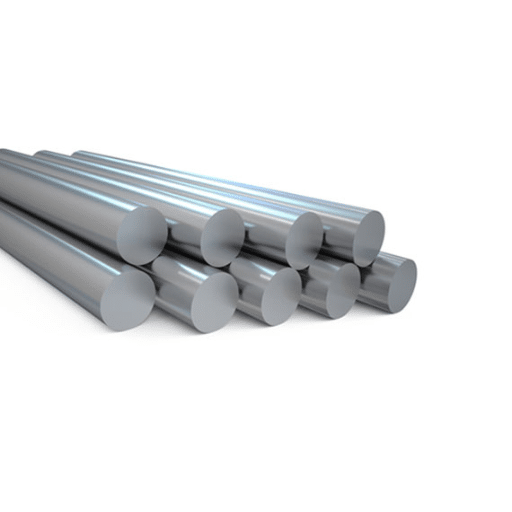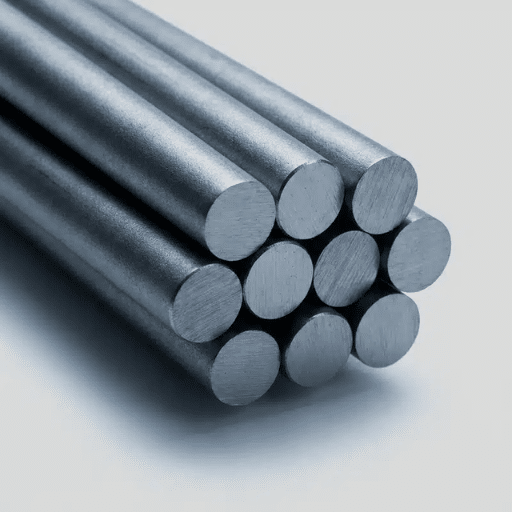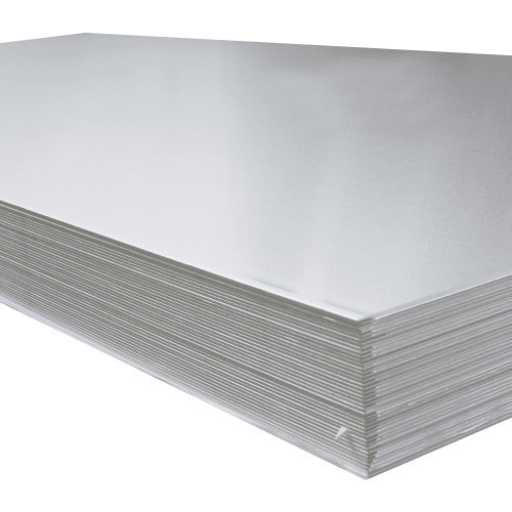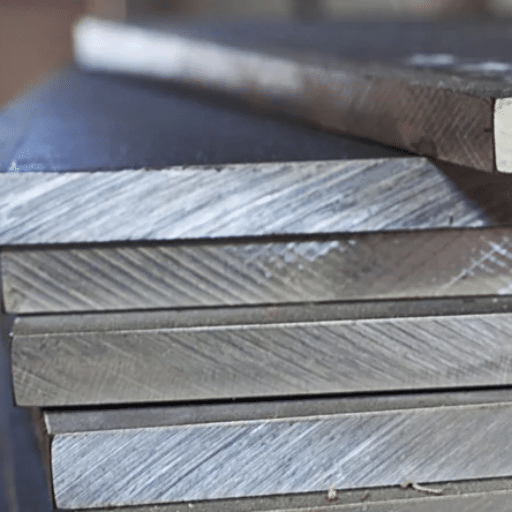
904L stainless steel (UNS N08904) is a low-carbon, fully austenitic grade carrying 19.0–23.0% chromium, 23.0–28.0% nickel, 4.0–5.0% molybdenum and 1.0–2.0% copper. The headline 904L stainless steel properties in the annealed condition are a minimum tensile strength of 490 MPa, a minimum yield strength of 220 MPa, elongation of at least 35%, a density of 7.90–8.00 g/cm³ and a pitting resistance equivalent number (PREN) of roughly 34 to 36.
That paragraph is the short answer. The longer problem is that if you search for these same numbers across supplier pages, you’ll find four different densities, three different maximum service temperatures, and a PREN that ranges from 32 to 45.
Every one of those pages looks authoritative. None tells you which number belongs on your drawing.
Pull up five 904L datasheets and compare the density line. You’ll see 7.90, 7.95, 7.98, 8.00 and 8.24 g/cm³. One of those figures is simply wrong, and it’s been copied from page to page for years because nobody checks a number they can find in five places.
When Tomás, a pressure-vessel engineer at a fertilizer plant, sized an expansion joint against a thermal expansion coefficient pulled from a supplier page with no temperature interval stated, the number looked fine. The interval was wrong for his 300°C service; his joint travel came up short by nearly 20%, and the fix came out of the project contingency. The datasheet wasn’t lying; it just wasn’t complete.
This article fixes that. It gives you one internally consistent set of 904L properties- chemical, mechanical, physical, and thermal- with every minimum traced to the governing standard and every figure that circulates online but fails against mill data flagged as such. For the full grade treatment, including corrosion envelopes and 2026 pricing, start with our complete 904L stainless steel guide.
Key Takeaways
- Density is 7.90–8.00 g/cm³. The 8.24 figure on several supplier pages is a propagated error with no basis in mill data.
- Minimums aren’t typicals. ASTM B625 requires ≥490 MPa tensile and ≥220 MPa yield. Mills typically deliver 505–560 MPa. A certificate showing 505 MPa is normal, not a weak heat.
- 904L can’t be hardened by heat treatment. It’s fully austenitic, so work hardening is the only strengthening mechanism. Annealing restores properties; it never raises strength.
- PREN works out to 35.65 using Cr 20, Mo 4.5 and N 0.05. Copper, the element that defines this grade, is deliberately excluded from the formula, which is why inflated “PREN 40–45” claims appear on pages that don’t show their arithmetic.
- The practical service ceiling is about 400°C, with ASME design stress values published to 371°C and sigma-phase embrittlement becoming a risk above roughly 550°C. The 870°C figure quoted online is incorrect for continuous service.
- Always quote CTE with its temperature interval. 904L sits near 15.8 µm/m·°C over 20–100°C and rises to about 16.9 µm/m·°C over 20–400°C. A single number without the interval is unusable for design.
904L Stainless Steel at a Glance

If you need the grade’s identity block for a specification sheet or a purchase requisition, this is it. Every designation below refers to the same material.
| Property | Value |
|---|---|
| UNS number | N08904 |
| EN / DIN designation | 1.4539 |
| EN symbol | X1NiCrMoCu25-20-5 |
| AISI / common name | 904L |
| Chinese digital grade | S31782 |
| Chinese designation (current) | 015Cr21Ni26Mo5Cu2 |
| Family | Fully austenitic, low-carbon, high-alloy |
| Typical PREN | 34–36 (35.65 worked) |
| Density | 7.90–8.00 g/cm³ |
| Melting range | 1300–1390°C |
| Max practical service temperature | ~400°C |
| Delivery condition | Solution annealed (1090–1175°C, water quench) |
Two notes on that table. First, the Chinese designations matter more than most Western buyers expect, because they appear on every mill certificate from Chinese producers. Our 904L equivalent grades reference cross-references S31782, 015Cr21Ni26Mo5Cu2 and the older 00Cr20Ni25Mo4.5Cu against their ASTM and EN counterparts. Second, three values in the table are contested online, and this article addresses each one directly.
904L Chemical Composition
Composition determines everything downstream, so it’s worth having the standard window in front of you before the mechanical and physical tables make sense.
| Element | Min (%) | Max (%) | Function |
|---|---|---|---|
| Carbon (C) | n/a | 0.020 | Low carbon eliminates sensitisation; removes the need for a stabiliser |
| Chromium (Cr) | 19.0 | 23.0 | Passive film formation; the base of corrosion resistance |
| Nickel (Ni) | 23.0 | 28.0 | Austenite stability, chloride SCC resistance, lower yield strength |
| Molybdenum (Mo) | 4.0 | 5.0 | Pitting and crevice resistance; the dominant PREN contributor |
| Copper (Cu) | 1.0 | 2.0 | Reducing-acid resistance; the defining addition of this grade |
| Nitrogen (N) | n/a | 0.10 | Incidental only. Not a deliberate strengthening addition |
| Manganese (Mn) | n/a | 2.00 | Austenite stabiliser; residual from melting |
| Silicon (Si) | n/a | 1.00 | Deoxidation residual |
| Phosphorus (P) | n/a | 0.045 | Residual; kept low for weldability |
| Sulfur (S) | n/a | 0.035 | Residual; low sulfur harms machinability |
| Iron (Fe) | Balance | Balance | Matrix |
Per ASTM B625 and EN 10088-2. Our 904L stainless steel pillar page works through each element’s metallurgical role.
What the Composition Predicts
Four links between chemistry and the numbers that follow are worth holding onto.
Copper is why this grade exists. Copper at 1.0–2.0% improves performance in reducing acids, exactly where plain chromium-nickel-molybdenum grades struggle. It’s also deliberately excluded from the PREN formula, a detail that explains much of the grade’s inflated PREN claims online.
Molybdenum sets the pitting resistance. Every 1% of molybdenum adds 3.3 points of PREN. Going from 316L’s 2–3% to 904L’s 4–5% is the single largest driver of the grade’s chloride performance.
High nickel costs you strength. Nickel at 23–28% stabilises the austenite. That’s why the material can’t be hardened by heat treatment, and why yield strength sits near 220 MPa rather than 2205 duplex’s 450 MPa.
Nitrogen is incidental, not engineered. At ≤0.10%, nitrogen in 904L is a residual. Compare that with 254 SMO at 0.18–0.22%, where nitrogen is a deliberate strengthening and PREN addition.
904L Stainless Steel Properties: Mechanical Data
These are the annealed-condition values. Every minimum is the standard’s requirement; every typical reflects what mills actually ship.
| Property | Symbol | Minimum | Typical | Unit | Basis |
|---|---|---|---|---|---|
| Tensile strength | Rm | 490 | 490–700 | MPa | ASTM B625 / EN 10088-2 |
| Yield strength, 0.2% proof | Rp0.2 | 220 | 220–310 | MPa | ASTM B625 |
| Yield strength, 1.0% proof | Rp1.0 | 250 | 250–340 | MPa | EN 10088-2 |
| Elongation | A | 35 | 35–45 | % | ASTM B625 |
| Hardness | n/a | n/a | 70–90 | HRB | Mill datasheets |
| Hardness, upper bound | n/a | n/a | ≤192–230 | HBW | Product-form dependent |
| Modulus of elasticity | E | n/a | 190–195 | GPa | Mill datasheets |
Why Minimums and Typicals Differ
This distinction causes more procurement arguments than any other property issue on 904L.
A minimum is the floor your material test report must clear. A typical is what the mill usually delivers. If your certificate shows 505 MPa tensile against a 490 MPa minimum, that heat passes, and it’s a normal heat. It isn’t a weaker batch, and it isn’t grounds for rejection.
When a QC manager at an Antwerp fabricator rejected a 904L plate lot in early 2025 for sitting 15 MPa above the ASTM B625 minimum, the mill’s reply was a one-line email. The material met specification and the rejection was invalid. The lot shipped, but the dispute cost three weeks of schedule. Reading a typical range as a guaranteed floor is the mistake that caused it.
The trap works the other way too. An engineer who reads “tensile 490–700 MPa” and treats 700 MPa as the design value overestimates the material. For any design calculation, the minimum is the number that matters. Everything above it is margin you didn’t pay for and can’t rely on.
Comparing certificates against the wrong product form’s minimums is a real and common error. Our 904L plate and sheet guide and 904L pipe and tube guide hold the form-specific detail.
904L Can’t Be Hardened by Heat Treatment
Every datasheet states that 904L isn’t hardenable by heat treatment. Very few explain what that actually costs you.
Because the structure is fully austenitic at all temperatures, there’s no martensitic transformation to trigger and no precipitation-hardening mechanism to exploit. Work hardening is the only route to higher strength, and it comes with side effects. Each forming pass raises yield strength and hardness, reduces ductility in the worked section, and slightly increases magnetic response.
The practical consequences matter. Cold-formed components carry higher strength than the annealed table suggests, so a formed part may be stronger than your calculation assumed. But that same part may also fall short on corrosion performance, because cold work creates strain energy that undermines the passive film. Where a component is both cold-formed and corrosion-critical, solution anneal it after forming.
There’s also a procurement red flag buried in this fact. A supplier offering “hardened 904L” doesn’t understand the grade. There’s no such condition.
The Strength Reality Check Against Duplex
Here’s the honest comparison that most 904L pages avoid.
904L gives you roughly 220 MPa yield strength at two to two-and-a-half times the cost of 316L. Grade 2205 duplex gives you roughly 450 MPa yield strength, at lower cost, with corrosion performance that’s comparable or better in many chloride environments.
If your design driver is strength, pressure rating or weight, 904L is the wrong starting point. Start with duplex instead. Our 904L vs 2205 duplex comparison works through that trade-off, including the environments where duplex genuinely loses.
Not sure whether your design is strength-driven or corrosion-driven? Send us the wall thickness calculation, operating pressure and media, and our metallurgical engineers will tell you within 24 hours whether 904L is the right call or whether duplex serves you better at lower cost. Speak with our metallurgical team
904L Stainless Steel Properties: Physical Data

This is the section the English-language SERP handles worst. Most pages stop at density, modulus and melting point. Process engineers designing heat exchangers, expansion joints and thermal cycling components need considerably more, and they currently have to open a PDF or register for a database to get it.
| Property | Value | Notes |
|---|---|---|
| Density | 7.90–8.00 g/cm³ | At 20°C |
| Modulus of elasticity | 190–195 GPa (28–29 Msi) | 20°C |
| Shear modulus | ~73 GPa | 20°C |
| Poisson’s ratio | ~0.333 | 20°C |
| Melting range | 1300–1390°C | Solidus to liquidus |
| Specific heat | 450–500 J/kg·K | 0–100°C |
| Thermal conductivity | 11.5–12.0 W/m·K | At 20°C |
| Thermal conductivity | ~12.9 W/m·K | At 100°C |
| Mean CTE | 15.8 µm/m·°C | 20–100°C |
| Mean CTE | ~16.9 µm/m·°C | 20–400°C |
| Electrical resistivity | ~952 nΩ·m (9.52 µΩ·cm) | 20°C |
| Relative magnetic permeability | ~1.002 | Annealed condition |
Per mill datasheets, including the ATI Allegheny Ludlum AL 904L datasheet.
The Datasheet Inconsistency Audit
This table exists because the contradictions are real, and they cost people money. Here’s what circulates, what the defensible value is, and where the discrepancy comes from.
| Property | Values seen online | Defensible value | Why the discrepancy exists |
|---|---|---|---|
| Density | 7.90 / 7.95 / 7.98 / 8.00 / 8.24 g/cm³ | 7.90–8.00 g/cm³ | 8.24 has no basis in mill data. It’s a typographical error that has propagated between supplier pages |
| Max service temperature | 400 / 450 / 550 / 870°C | ~400°C practical | Four different questions being answered by the same label. The 870°C figure is incorrect for continuous service |
| PREN | 32 / 34 / 35 / 36 / 40–45 | 34–36 | The 32–36 spread reflects legitimate Cr/Mo/N window variation. 40–45 is unachievable at N ≤0.10% |
| Tensile strength | ≥490 / 490–700 / 520–720 MPa | ≥490 MPa minimum | Minimum vs typical vs product-form-specific values presented without labels |
| Hardness | ≤90 HRB / 70–90 HRB / ~150 HB / ≤230 HB | 70–90 HRB annealed | Rockwell B and Brinell values mixed, and different product forms compared as equivalents |
| Modulus of elasticity | 190 / 193 / 195 / 200 GPa | 190–195 GPa | Test-method and temperature variation between sources |
| Thermal conductivity | 11.5 / 12 / 12.9 / 13 W/m·K | 11.5–12.0 at 20°C | Temperature omitted. Conductivity rises with temperature; a bare number is unusable |
| CTE | 15 / 15.5 / 15.8 / 16.1 / 16.9 µm/m·°C | Depends on interval | Interval omitted. Always state the range the coefficient applies to |
Two rules follow, and they should govern how you read any 904L datasheet, including ours.
Every property value needs its condition. Annealed or cold-worked isn’t optional information. The numbers differ materially between the two.
Every temperature-dependent property needs its interval. A CTE without a stated temperature range isn’t an engineering value. Neither is a thermal conductivity without a stated temperature. Both vary across the service range by amounts that matter.
904L Magnetic Properties
Is 904L magnetic? In the annealed condition, no. Relative permeability sits at approximately 1.002, effectively indistinguishable from non-magnetic for most purposes.
Cold working changes this slightly. The strain-induced transformation that follows deformation raises permeability, though far below the level of any ferritic or martensitic grade. For most applications this shift is irrelevant.
For instrument components, sensor housings and any assembly where magnetic signature is a specification item, it isn’t. If a cold-formed 904L part carries a permeability requirement, solution anneal it after forming and verify the property on the finished component rather than the incoming plate.
PREN: Deriving 904L’s Pitting Resistance Equivalent Number
PREN is the industry’s shorthand for chloride resistance, and it is the one 904L stainless steel property most often quoted incorrectly.
The Calculation, Worked
The standard formula for austenitic stainless steels is:
PREN = %Cr + 3.3 × %Mo + 16 × %N
Using nominal values of Cr 20, Mo 4.5 and N 0.05:
- Chromium contribution: 20
- Molybdenum contribution: 3.3 × 4.5 = 14.85
- Nitrogen contribution: 16 × 0.05 = 0.8
- Total: 35.65
Across the permitted composition windows (Cr 19–23, Mo 4–5, N up to 0.10), the value ranges from roughly 32 to 36. That range is legitimate. It reflects real variation in chemistry within the standard.
What isn’t legitimate is a PREN of 40–45. Reaching 40 would require either a molybdenum level above the specification ceiling or a nitrogen content several times higher than 904L permits. Pages quoting it generally don’t show their arithmetic, which is the tell.
Why Copper Isn’t in the Formula
This catches people out. Copper at 1.0–2.0% is the defining addition of 904L, and it’s deliberately absent from the PREN calculation.
PREN measures resistance to localized chloride attack, which is a function of chromium, molybdenum and nitrogen. Copper’s contribution is different. It improves performance in reducing acids, a general corrosion mechanism rather than a pitting one. Copper doesn’t meaningfully raise pitting resistance, so it doesn’t belong in the pitting metric.
The consequence is worth stating plainly. 904L’s performance in sulfuric and phosphoric acid is better than its PREN suggests. Its performance in chloride environments is exactly what its PREN suggests, and no better. Buyers who assume copper adds chloride resistance over-estimate the grade in seawater duty.
What the Number Means in Practice
A PREN of roughly 35 places 904L above 316L at about 24, close to 2205 duplex at about 34, and well below 254 SMO and AL-6XN at 42–47.
The number has a hard specification consequence. NORSOK-style guidance and most offshore specifications require a PREN of at least 40 for reliable continuous natural-seawater immersion. 904L doesn’t meet that threshold. That single fact resolves most of the confusion about whether 904L is a seawater grade. The answer is that it isn’t one.
The chloride thresholds confirm it. 904L tolerates roughly 2,000 ppm chloride at 25°C, falling to about 100 ppm at 100°C. Media-specific corrosion rate data lives in our 904L corrosion resistance guide.
One terminology point, stated briefly because it affects specifications. Because PREN falls below 40 and nitrogen isn’t a deliberate addition, 904L is strictly a high-alloy austenitic rather than a super austenitic in the NORSOK sense. The pillar article covers that argument in full for anyone defending the classification on a project document.
904L Properties at Temperature
904L stainless steel properties don’t hold constant across the service range. Most datasheets give you one room-temperature column and leave you to interpolate. Here’s the shape of the curve instead.
| Property | 20°C | 100°C | 200°C | 300°C | 400°C |
|---|---|---|---|---|---|
| Tensile strength (MPa) | 490–700 | 450–620 | 415–560 | 390–520 | 370–490 |
| Yield strength, Rp0.2 (MPa) | 220–310 | 180–260 | 160–225 | 145–205 | 135–190 |
| Modulus of elasticity (GPa) | 190–195 | 186–190 | 180–185 | 174–179 | 168–173 |
| Thermal conductivity (W/m·K) | 11.5–12.0 | 12.5–12.9 | 13.8–14.4 | 15.0–15.7 | 16.1–16.9 |
| Mean CTE (µm/m·°C) | n/a | 15.8 | 16.3 | 16.6 | 16.9 |
Values are indicative engineering ranges compiled from mill datasheets. Confirm against the governing standard for any design calculation.
The pattern is consistent across austenitic grades. Strength and stiffness decline steadily, thermal conductivity rises, and expansion increases. By 400°C, yield strength has fallen roughly 30% from its room-temperature value, and the modulus has dropped about 12%.
That decay is why the temperature limit matters more than the headline maximum. At a nominal 400°C you aren’t working with a material that merely carries a restriction; you’re working with one whose strength has measurably declined, and your wall thickness calculation needs the value at temperature.
The Four Temperature Limits, Resolved
The wildly different service temperatures quoted online aren’t really contradictory. They answer four different questions.
| Limit | Value | What it governs |
|---|---|---|
| ASME design stress publication limit | 371°C | The highest temperature at which ASME BPVC Section II-D publishes allowable stress values |
| Practical maximum service temperature | ~400°C | The working ceiling most mill datasheets state for continuous service |
| ER385 weld deposit limit | 350°C | The ceiling for matching filler-metal deposits in severe service |
| Sigma-phase embrittlement onset | ~550°C | Where chromium-molybdenum-rich phases begin precipitating at grain boundaries |
| The 870°C figure | n/a | Incorrect for continuous service. It circulates widely and has no basis in the datasheets |
The resolution is straightforward. If your application runs continuously above roughly 400°C, 904L isn’t the grade for you, regardless of which number you found online.
The Atlas Steels 904L data sheet states the sigma advisory explicitly, which is why it’s a useful cross-check against the supplier pages that omit it.
Sigma Phase: Why High Temperature Is a Properties Problem
Above approximately 550°C, chromium-molybdenum-rich sigma and chi phases precipitate along grain boundaries. The consequences are cumulative and mostly irreversible without re-annealing.
Toughness falls. Ductility falls. Corrosion resistance falls, because the precipitates deplete chromium from the adjacent matrix and create paths for intergranular attack. A component that passes a room-temperature inspection can still fail in service at temperature for reasons that never appear on the incoming certificate.
904L resists this better than 316L or 317L, thanks to its higher nickel content. That’s why the grade can be used at 400°C where standard austenitics are more constrained. But resistance isn’t immunity. The number to design to is roughly 400°C, not the highest figure any supplier quotes.
The mechanism and the full temperature-limit framework are covered on our 904L stainless steel guide.
Cryogenic Behaviour
Below ambient, 904L behaves well. The fully austenitic face-centred cubic structure has no ductile-to-brittle transition, so the material retains toughness down to approximately -196°C. That’s the same structural reason the grade is non-magnetic, and it’s why austenitic grades rather than ferritic ones serve cryogenic duty.
Heat Treatment and Working Windows

Heat treatment for 904L is simple in description and unforgiving in execution. There’s one treatment, and the cooling step is the part that matters.
Solution Annealing: 1090–1175°C, Followed by Water Quench
Solution annealing serves three purposes. It dissolves carbides and any sigma phase present, it restores chemical homogeneity across the section, and it returns the alloy to the condition in which its corrosion resistance was characterized.
The quench is the treatment. This is the point most often lost. A slow cool after annealing re-precipitates exactly the phases the anneal just dissolved, leaving you with a component that was correctly heated and incorrectly finished. Water quenching or another rapid cooling method is mandatory, and the cooling rate should appear on the process record.
Two related points follow.
Annealing restores; it never hardens. Because 904L is fully austenitic, no heat treatment raises its strength. If a specification calls for higher strength, the answer is a different grade, not a different heat treatment.
Stress relief isn’t a separate low-temperature treatment for this grade. Where stress relief is genuinely required, treat it as a full solution anneal with a rapid quench. A conventional low-temperature stress relief will precipitate carbides in the sensitisation range and do more harm than the residual stress it was meant to remove.
Hot Working: 1000–1175°C
Forge at a maximum of approximately 1180°C and finish above 900°C. Working below the minimum risks cracking in the embrittlement range, and working above the maximum risks grain growth and incipient melting.
Any hot-worked component requires a post-form solution anneal. Hot working doesn’t leave the material in its characterized condition, and the corrosion performance of an unannealed forged component shouldn’t be assumed.
Cold Forming and Work Hardening
Austenitic grades work-harden rapidly, and 904L is no exception. Every forming pass raises yield strength and hardness, with no heat-treatment ceiling to relieve the effect.
The forming itself is straightforward. 904L bends to small radii cold, and its formability is better than duplex grades, a genuine advantage over 2205 in fabrication-heavy work. The limitation is what happens to the material rather than the process.
Where a formed component is corrosion-critical or carries a permeability requirement, solution anneal it after forming. Cold work leaves strain energy in the structure that degrades passive film performance, and re-annealing is the only way to recover it.
Machinability
904L is a low-sulfur, high-purity grade, and that purity costs you machinability. The material is gummy, prone to glazing, and work-hardens quickly under the tool. It machines noticeably worse than the free-machining austenitics, and worse than 316L.
In practice this means slower surface speeds than you’d use on a standard austenitic, positive feeds to get under the work-hardened skin rather than dwelling on it, rigid setups, and no repeated spring passes. The welding and fabrication parameters, including filler-metal selection and heat input limits, live in our dedicated 904L welding and fabrication guide.
Reading a 904L Certificate: Which Property, Which Standard
The minimums in the mechanical table above come from specific standards, and those standards are form-specific. Comparing an incoming certificate against the wrong form’s minimums is a common and entirely avoidable error.
| Product form | Governing standard | Notes |
|---|---|---|
| Plate and sheet | ASTM B625, ASTM A240 (ASME SB625 / SA240) | B625 is the N08904-specific plate standard |
| Seamless pipe | ASTM B677 (also ASTM A312) | B677 is the N08904-specific seamless standard |
| Welded pipe | ASTM A312, ASTM A358 | A358 covers high-temperature service |
| Seamless tube | ASTM B673 | Verify against the current ASTM scope statement |
| Welded tube | ASTM B674 | Verify against the current ASTM scope statement |
| Heat-exchanger tube | ASTM A249 | |
| Bar | ASTM A479, ASTM B649 | A479 for pressure-vessel service |
| Forgings | ASTM A182 |
Supplier charts are inconsistent about the B673 versus B674 assignment, so confirm the current scope statement before it appears on your purchase order. Our 904L pipe and tube specifications and 904L plate and sheet specifications carry the form-specific detail.
What to Verify Beyond the Headline Numbers
A certificate can pass on tensile and yield while still representing material you shouldn’t accept. Four checks catch the cases that matter.
| Check | Specification window | Why it matters |
|---|---|---|
| Copper line | 1.0–2.0% Cu | Copper is the element substituted material omits, because it’s expensive and its absence isn’t obvious from a routine tensile test. Below 1.0%, the material isn’t 904L |
| Molybdenum line | 4.0–5.0% Mo | Substitution is less common here than on copper but still occurs, and it directly reduces pitting resistance |
| Carbon | ≤0.020% C | Higher carbon removes the sensitisation advantage that justifies the low-carbon grade, particularly in welded assemblies |
| Delivery condition | Solution annealed, rapid quench | An annealed material that was slow-cooled isn’t in the condition the mechanical properties describe |
A 2024 substitution case shows why the copper line matters. A distributor shipped a “904L” tube bundle to a European chemical plant with a mill certificate claiming 1.4% copper, and the mechanical numbers passed. A handheld X-ray fluorescence check on arrival read 0.4% copper, and the bundle went back. Material substituted on the copper line passes every mechanical test you run, which is exactly why positive material identification exists.
Beyond the certificate, third-party inspection adds a layer that paperwork can’t. EN 10204 3.1 covers a manufacturer’s inspection certificate; 3.2 adds independent verification, which most EPC and nuclear projects require. Positive material identification on the copper and molybdenum lines is the single highest-value verification step for this grade, because it tests the finished component rather than the paperwork. Our quality and certification process covers how we run that verification in-house on every batch.
904L Properties FAQ
What is the density of 904L stainless steel?
904L density is 7.90–8.00 g/cm³ at 20°C. The 8.24 g/cm³ figure that appears on some supplier pages is a propagated typographical error with no basis in mill datasheets, and it shouldn’t be used for weight calculations.
What is the maximum service temperature of 904L?
The practical continuous service ceiling for 904L is approximately 400°C. ASME design stress values are published to 371°C, and sigma-phase embrittlement becomes a risk above roughly 550°C. The 870°C figure quoted on some pages is incorrect for continuous service.
Is 904L stainless steel magnetic?
No. In the annealed condition, 904L is essentially non-magnetic, with a relative permeability of about 1.002. Cold working raises permeability slightly through strain-induced transformation, but it stays far below ferritic or martensitic grades. Solution annealing forms components if permeability is a specification item.
Can 904L be hardened by heat treatment?
No. 904L is fully austenitic, so no martensitic or precipitation-hardening mechanism exists. Work hardening is the only route to higher strength. Solution annealing restores properties after forming, but it never raises strength above the annealed values.
What is the PREN of 904L?
904L’s PREN is approximately 32–36, with a typical value of 35.65 calculated as Cr 20 + (3.3 × Mo 4.5) + (16 × N 0.05). Copper is deliberately excluded from the formula. The value falls below the PREN ≥40 threshold used for reliable continuous seawater service.
What is the tensile strength of 904L?
Minimum tensile strength is 490 MPa (71 ksi) in the annealed condition per ASTM B625. Mills typically deliver 490–700 MPa depending on product form and thickness. For design calculations, use the minimum, not the top of the typical range.
What is the yield strength of 904L?
Minimum yield strength at 0.2% proof is 220 MPa (32 ksi) annealed. That’s substantially lower than 2205 duplex at approximately 450 MPa, and it’s the grade’s key mechanical limitation. Strength-driven or weight-driven designs should evaluate duplex first.
Does 904L work harden?
Yes, rapidly. Each cold-forming pass raises yield strength and hardness with no heat-treatment ceiling to relieve the effect. Cold work also modestly increases magnetic permeability and can degrade corrosion performance in the worked zone, so formed components should be solution annealed where either property is critical.
What is 904L stainless steel equivalent to?
904L is UNS N08904, EN/DIN 1.4539, and X1NiCrMoCu25-20-5. The Chinese designations are S31782 and 015Cr21Ni26Mo5Cu2, with 00Cr20Ni25Mo4.5Cu as the older form. Our 904L equivalent grades cross-reference maps the full set.
What is the melting point of 904L?
The melting range is approximately 1300–1390°C, from solidus to liquidus. This matters for welding and hot working rather than for service temperature, which is limited by sigma-phase precipitation far below the melting range.
What is the thermal expansion of 904L?
The mean coefficient of thermal expansion is approximately 15.8 µm/m·°C over 20–100°C, rising to about 16.9 µm/m·°C over 20–400°C. Always specify the temperature interval alongside the value, because a CTE quoted without one isn’t usable for expansion-joint or thermal-stress design.
Conclusion
The whole 904L stainless steel properties question comes down to three numbers and two honest limits.
The three numbers. PREN is 35.65 when you work it out, which places 904L above 316L and below the 6Mo grades. Yield strength is 220 MPa minimum, roughly half of what 2205 duplex delivers. Practical service temperature is about 400°C, with the widely repeated 870°C figure simply wrong.
The two limits. This grade can’t be hardened by heat treatment, and it doesn’t qualify as a seawater material under the PREN ≥40 convention. Both are statements the grade’s own chemistry makes, and knowing them early prevents expensive specification mistakes.
Everything else here follows from those facts. The property-versus-temperature decay is why the 400°C ceiling matters more than a headline maximum. The copper exclusion from PREN is why acid performance and chloride performance aren’t the same story. The minimum-versus-typical distinction is why a 505 MPa certificate is normal rather than disappointing.
If you’re specifying 904L, the next step is the certificate rather than the datasheet. Ask for the copper and molybdenum lines, confirm the delivery condition and quench method, and run positive material identification if the application warrants it.
Need 904L plate, sheet, bar, pipe, or tube with verified properties? Send us your specification, and we’ll return availability, pricing, and the documentation package within 24 hours. Every batch ships with a full material test report, spectral analysis, and third-party inspection support where your project requires it. Request a 904L quotation → Or browse our stainless steel product range to see the full grade portfolio.