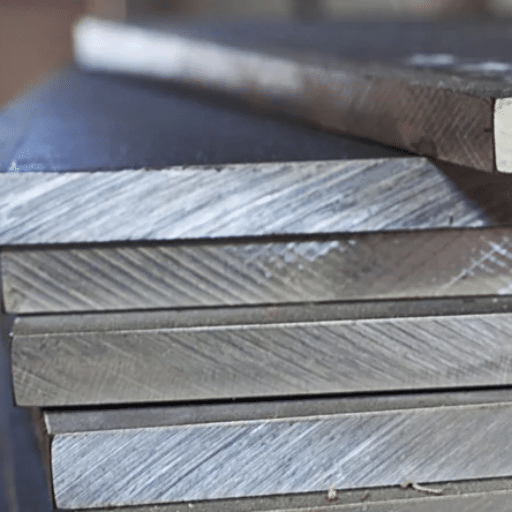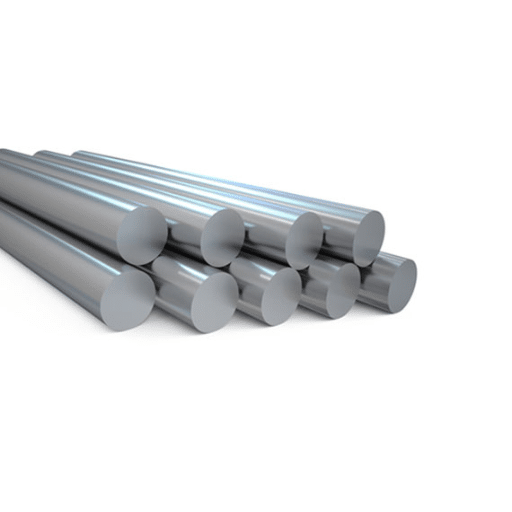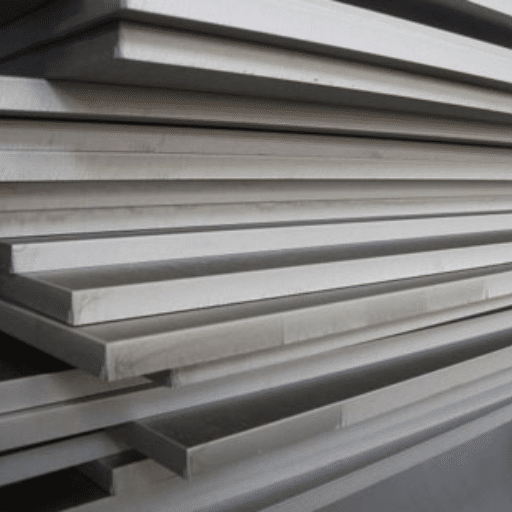
904L stainless steel plate (UNS N08904) is a low-carbon super-austenitic grade supplied to ASTM A240/A240M and A480/A480M in the solution-annealed and pickled condition. It covers hot-rolled plate from 3.0 mm to about 60 mm, and cut-to-size sheet from roughly 0.3 mm, in widths to 2000 mm, for vessels, storage tanks, absorber liners and tubesheets.
Here’s the part most plate pages get wrong. Almost every one of them cites ASTM B625 as the standard for 904L plate. Under B625-21, that’s no longer true: the standard’s own scope moved UNS N08904 to A240/A240M and A480/A480M. The legacy citation survives because it sits on thousands of old drawings and mill certificates.
A 904L plate order is decided by five lines: the governing standard, the thickness and its tolerance, the finish, the edge condition, and the certification. Get one wrong and the plate that arrives isn’t the plate your vessel was designed around.
This guide is written for the person writing the purchase order, not the person browsing a catalogue. It sets out which standard governs 904L plate today, the real size and tolerance tables from ASTM A480, finish and edge selection logic, what cut-to-size tolerances each process holds, 2026 plate pricing by thickness, and the two elements to verify on receipt. It closes with a PO clause list you can use directly. It sits inside our complete 904L stainless steel guide, alongside the wider stainless steel grade range we supply.
Key Takeaways
- 904L plate is governed by ASTM A240/A240M plus A480/A480M today. B625-21 moved UNS N08904 out of its own scope. A B625 citation is legacy, not necessarily an error on an existing approved drawing.
- Plate is 4.76 mm and over, and over 254 mm wide. Sheet is under 4.76 mm and 609.6 mm or wider. That boundary decides which product you are actually buying, and no ranking page states it.
- Thickness tolerance comes from ASTM A480: from ±0.04 mm on thin sheet to ±1.5 mm on heavy hot-rolled plate. The “±0.01 mm or ±1%” figure competitors publish is not a plate tolerance.
- No.1 (HRAP) is the correct default finish for vessel and tank plate. 2B is a cold-rolled sheet finish, not a corrosion upgrade.
- Specify solution annealed and pickled explicitly. It is the correct default for this grade, and defaults get lost in translation.
- Verify copper (1.0-2.0%) and molybdenum (4.0-5.0%) by PMI on receipt. Those are the two lines a substitute grade fails first.
Need a plate price against your exact thickness and finish? Send your specification to our technical team and we will confirm availability, tolerance and a certified quotation within 24 hours. Request a 904L plate quotation.
What Is 904L Stainless Steel Plate?

Definition
904L plate is a flat-rolled, low-carbon austenitic stainless steel with high nickel and molybdenum plus a deliberate copper addition, supplied cut to size for pressure and corrosion service. It’s solution annealed and pickled, and it’s ordered to a stated thickness and tolerance rather than to a gauge.
Designations You Will See on the MTR
904L is one grade wearing many names, and the plate certificate will usually carry two or three of them at once:
UNS N08904 · EN/DIN 1.4539 · X1NiCrMoCu25-20-5 · AISI 904L · JIS SUS 890L · Swedish SS 2562. The Chinese national-standard designations are S31782 (digital), 015Cr21Ni26Mo5Cu2 (current), and 00Cr20Ni25Mo4.5Cu (superseded) under GB/T 20878. Our 904L equivalent grades table maps the full cross-reference, including which designation your supplier’s MTR is likely to print.
The composition that defines the grade, verified against ASTM A240/A240M, is what makes plate purchasing testable: Cr 19.0-23.0%, Ni 23.0-28.0%, Mo 4.0-5.0%, Cu 1.0-2.0%, with carbon capped at 0.020% and nitrogen at 0.10%. Those last two numbers, Mo and Cu, are the ones that matter at goods-in.
Sheet vs Plate vs Strip: The Boundary That Changes Your Order
“904L sheet and plate” gets used interchangeably across the internet, which is why thickness ranges for the same grade are quoted as 0.3-1200 mm, 3-300 mm and 4-100 mm in the same search results. The definitions are exact, and they are identical across the A240/A480 convention and B625 §1.1:
| Product form | Thickness | Width |
|---|---|---|
| Plate | 4.76 mm (3/16 in) and over | Over 254 mm (10 in) |
| Sheet | Under 4.76 mm | 609.6 mm (24 in) and over |
| Strip | Under 4.76 mm | Under 609.6 mm (24 in) |
The 4.76 mm line isn’t a supplier preference. It’s where hot-rolled plate processing, the A578 ultrasonic testing regime and vessel-plate ordering begin. Ask for “6 mm sheet” and a competent supplier will ship you plate, because that’s what 6 mm flat-rolled product is.
One nuance worth stating, because it causes real confusion. Trade practice, especially in China and wider Asia, calls hot-rolled flat product from about 3.0 mm upwards “plate” (中厚板), and you will see 904L stainless steel plate offered from 3.0 mm as a result. Under the A240 definition, a 3.0 mm product is sheet, because it sits below the 4.76 mm thickness threshold. Both statements are true: the trade name follows the mill’s rolling route, and the standard follows the thickness and width. When your design code or inspection procedure cares which one applies, go by the definition, not the trade label.
Which Standard Governs 904L Plate? A240, A480 and the B625 Legacy
This is the section that matters most, because it is where most of the search results are wrong and where a real procurement decision hangs.
What ASTM A240/A240M and A480/A480M Cover
ASTM A240/A240M is the material specification: it lists the grade, its chemistry and its mechanical requirements. ASTM A480/A480M is the general-requirements companion: it holds the dimensional tolerances, the permissible variations, the finish definitions and the testing references that A240 invokes. Order plate to A240 and A480 governs how thick, how wide and how flat that plate may be. Nearly every tolerance figure in this article comes from A480.
The B625-21 Scope Change, Quoted
ASTM B625 was historically the specification for Ni-Fe-Cr-Mo-Cu-N low-carbon alloy flat product, and it did list N08904. Its 2021 revision changed that. The scope now reads, in the standard’s own words, that grades such as UNS N08904 which were previously in the specification are under the oversight of ASTM Committee A01, and that “the products of N08904 previously covered in this specification are now covered by Specifications A240/A240M and A480/A480M.” The reason given is that these grades have iron as the largest element by mass, which makes them stainless steels rather than nickel alloys.
Older editions (B625-05, B625-14) still list N08904. That’s exactly why the legacy citation persists across supplier pages, drawings and certificates.
Why B625 Still Appears, and What to Do About It
B625 is deeply embedded in legacy documentation. If your vessel package was specified in 2010, the datasheet said B625, and it may still be on the approved drawing today. Here is the practical handling:
- Do not silently “correct” an approved drawing. A standard change on a released drawing needs engineering sign-off, because other clauses (component standards, welding qualifications) may reference it.
- Do know what your plate is actually certified to. If the MTR comes back citing A240/A240M, the material is correct; the question is whether your QA release procedure accepts it against the B625 call-out.
- Write the current standard on new orders. New plate POs should cite A240/A240M with A480/A480M general requirements.
Elena, a QA engineer at a vessel fabricator in Rotterdam, hit exactly this in early 2026. An 8 mm 904L shell course arrived with an MTR citing A240/A240M while the drawing said B625. The plate was right and the paperwork was right; the release procedure was not, and the vessel sat for four days while the discrepancy was cleared. Her fix was simple: add a line to the incoming-inspection procedure noting that 904L flat product is now an A240 grade, so the next shipment clears in an hour rather than a week.
The ASME Section II Split: Verify Against Your Code Edition
One complication is worth knowing about, but it shouldn’t be taken as settled. In ASME Section II, N08904 has been reported to appear as an austenitic steel under SA-240, while SB-625 lists it as a non-ferrous material. Engineers have raised questions about which allowable-stress tables apply in Section II-D.
This is a Code-edition and interpretation question, not something to resolve from a supplier page. If your vessel is Code-stamped, confirm the applicable classification with your Authorized Inspector before you rely on either one. What an inspector wants is that the material certificate and the design basis agree, whichever route your Code edition takes. The allowable stresses that sit behind either route derive from the 904L mechanical property data for the annealed condition.
EN 10088-2 and EN 10028-7 for CE-Marked Equipment
For equipment destined for the EU, the plate is typically ordered to EN 10088-2 (flat products for general and corrosion-resistant service) or EN 10028-7 (flat products for pressure purposes), both of which list 1.4539. These route through the Pressure Equipment Directive for CE marking and carry EN 10204 3.1 certification as standard. If your project is PED-scoped, state the EN standard on the PO alongside the ASTM reference so the mill certificate matches the design code.
Which Standard Applies to Your Order: A Summary
| Order context | Governing standard | Notes |
|---|---|---|
| New plate order, US/ASTM basis | ASTM A240/A240M + A480/A480M | Current and correct; cite both |
| Legacy drawing or old MTR | ASTM B625 / ASME SB625 | Superseded for N08904; do not silently overwrite |
| Code-stamped vessel | SA-240 vs SB-625 | Confirm classification with your Authorized Inspector |
| EU / PED-scoped equipment | EN 10088-2 or EN 10028-7 | Grade 1.4539; EN 10204 3.1 as standard |
| Chinese-sourced material | GB/T 20878 (S31782) | The designation your MTR will print |
904L Plate and Sheet Sizes, Thicknesses and Stock Dimensions
The table below covers 904L stainless steel plate and sheet sizes as they are actually stocked. The ranges are indicative and supplier-dependent, because published figures across the market genuinely conflict. Where they do, we say so rather than pick one and pretend it is universal.
| Form | Thickness | Width range | Length range | Condition | Typical finish | Weight per m² |
|---|---|---|---|---|---|---|
| Hot-rolled plate | 3.0-60 mm (heavy to 100 mm+) | 1000-2000 mm | to 6000 mm | Solution annealed + pickled | No.1 / HRAP | 24 kg at 3 mm, 80 kg at 10 mm, 399 kg at 50 mm |
| Cold-rolled sheet | 0.3-6 mm (to 16 mm) | 1000-1500 mm | to 3048 mm | Solution annealed + pickled | 2B, 2D, BA | 4 kg at 0.5 mm, 16 kg at 2 mm |
| Strip | under 4.76 mm | under 609.6 mm | coil | Solution annealed + pickled | 2B / BA | by thickness |
The weight column is derived from a density of 7.95-8.0 g/cm³, which gives about 7.98 kg per m² per mm of thickness. For a 904L plate weight per square metre figure, multiply thickness in millimetres by 7.98.
Hot-Rolled Plate
Standard hot-rolled 904L plate runs 3.0 to 60 mm, with widths to 2000 mm. Heavier sections to 100 mm are made to order; claims of “up to 200 mm” you will see on some pages reflect hot-rolled slab stock rather than routinely held plate. Plate over about 60 mm is normally a project-specific rolling rather than a warehouse item, and lead time follows.
Cold-Rolled Sheet
Cold-rolled 904L stainless steel sheet starts around 0.3 mm, is commonly stocked at 0.3-6 mm, and is available to about 16 mm on request. Sheet is produced by cold rolling, which gives the tighter thickness tolerance and the smoother finish that cladding, liners and architectural work require.
Standard Stock Sizes
Holding true to the market, the sizes you can expect to find in stock are:
- Cold-rolled sheet: 1219 × 2438 mm (4 ft × 8 ft), 1219 × 3048 mm
- Hot-rolled plate: 1500 × 3000 mm, 1500 × 6000 mm, 1500 × 2000 mm, 1000 × 3000 mm, 2000 × 4000 mm
- Cut lengths: 2000 / 2438 / 2440 / 3000 / 5800 / 6000 mm, to 12 000 mm custom
Our stainless steel sheet and plate stock covers these standard sizes, and cut-to-size service turns them into a finished part.
904L Plate Thickness, Width and Flatness Tolerances
This is where 904L plate thickness tolerance data on the market becomes unusable. A tolerance quoted as “±0.01 mm or ±1%” is neither per-standard nor meaningful across a 3-60 mm range. Here are the real ASTM A480 figures.
Thickness Tolerance: Cold-Rolled (To ASTM A480)
| Nominal thickness (mm) | Tolerance (± mm) |
|---|---|
| 0.40 to < 0.60 | 0.04 |
| 0.60 to < 1.00 | 0.05 |
| 1.00 to < 1.60 | 0.06 |
| 1.60 to < 2.50 | 0.08 |
| 2.50 to < 4.00 | 0.10 |
| 4.00 to < 6.00 | 0.13 |
| 6.00 to < 8.00 | 0.18 |
Thickness Tolerance: Hot-Rolled Plate
Hot-rolled plate follows its own A480 rows, and the allowance widens with gauge: roughly ±0.3 to ±0.4 mm around 3-6 mm, opening to about ±1.5 mm at 25-50 mm. Always quote the standard’s table for the nominal thickness on the PO rather than a blanket figure.
Width Tolerance: Mill Edge vs Slit Edge
The detail almost no plate page publishes, and the one that decides whether a shell course fits:
| Edge condition | ≤1000 mm wide | >1600 mm wide |
|---|---|---|
| Mill edge | approx ±1.5 mm | approx ±3.0 mm |
| Slit edge | approx ±0.5 mm | approx ±1.5 mm |
Where width control matters, specify slit edge. Mill edge is the as-rolled edge and is cheaper, but it carries a wider allowance and can include the rolled-in edge condition that you may not want on a gasketed joint.
Flatness: The Tolerance That Costs Money
Flatness is controlled by A480 Tables 12 and 13 for hot-rolled annealed and pickled product. Indicative values run to roughly ≤10 mm/m for plate up to 1000 mm wide, ≤15 mm/m at 1001-1500 mm, and ≤20 mm/m above 1500 mm, with precision-leveled material available at about ≤3 mm/m.
Why that matters commercially: out-of-flat plate forces fit-up correction, widens root gaps, and drives weld repair in shell-course and tank-bottom assembly.
Daniel, a fabrication manager building phosphoric acid storage tanks, found this out on a 12 mm tank-bottom order. The plate was inside thickness tolerance, so his goods-in check passed it. But it was out of flat, and his fit-up time per bottom section doubled while root gaps widened enough to trigger weld repair on two seams.
The dimensional number on the certificate was fine. The cost landed in his labour and rework budget. Specify a flatness requirement, and if you need leveled material for automated fit-up, say so before the order is placed.
Not sure what flatness your fabrication can absorb? Send us your assembly method and we will advise which A480 flatness class keeps your fit-up predictable. Talk to our technical team.
904L Plate Surface Finishes: No.1, 2D, 2B, BA and When to Specify Each

Nearly every competitor lists finishes as an interchangeable menu. In practice, one finish is correct for plate and the rest are for other jobs.
No.1 / HRAP: The Correct Plate Default
No.1 finish is hot-rolled, annealed and pickled. It’s what the standard specification delivers for plate, and it’s the right choice for vessels, tanks and ducting. Pickling isn’t cosmetic. It removes the oxide scale left by hot rolling and restores the chromium-oxide passive film, which is the whole point of the surface treatment. Skipping it to save cost is a false economy on any corrosion-critical part.
2D and 2B: Cold-Rolled Sheet Finishes
2D is cold-rolled, annealed and pickled, dull grey. 2B is the same base with a final skin pass on polished rolls, giving a smooth, moderately reflective surface. 2B is the standard cold-rolled sheet finish. It’s smoother than No.1 and suits cladding, liners and architectural work, but its smoothness isn’t a corrosion advantage over a properly pickled No.1 plate. Choose 2B for appearance and dimensional consistency, not for corrosion.
BA, No.4, Hairline and No.8: Decorative, and What They Add
BA (bright annealed) is brighter and adds roughly 15-25% to the price. No.4, hairline and brushed are mechanical finishes used for architectural and hygienic work. No.8 / mirror is decorative and adds about $0.50-0.90/kg. None of them improves corrosion performance; all of them add cost. If your application is a tank interior, the correct answer is No.1, pickled, and money spent on BA elsewhere is money not spent on thickness or verification.
For a full picture of how surface condition affects pitting resistance in your medium, see our 904L corrosion resistance data.
904L Plate Cut-to-Size: Processes, Tolerances and What It Costs
Everyone advertises 904L plate cut to size. Almost nobody states what tolerance each process holds, which is the number that determines whether the part fits.
| Process | Typical finished-part tolerance | Best for |
|---|---|---|
| Shear | ±2 mm | Tank bottoms, structural plate, liner blanks |
| Slitting / slit-to-width | ±1 mm | Coil-width strip, edge-controlled sheet |
| Plasma / laser | ±0.5 mm | Weld-prep edges, gasketed joints, precise blanks |
| Waterjet | ±0.5 mm or better | Heat-sensitive, no heat-affected zone |
The selection rule is about the edge’s job. Sheared edges are acceptable for tank bottoms and structural plate, where a 2 mm allowance widens nothing that matters. Where a weld preparation or a gasketed joint demands a clean, straight edge, use laser, plasma or waterjet. Cutting is a finishing operation, not a commodity line item; specifying the process is how you avoid a part that is dimensionally wrong by 1.8 mm on an edge that needed 0.5 mm.
A marketplace listing for 904L plate cutting services shows a surcharge in the region of US$50 per ton on top of material cost, though that figure varies with process, thickness and part count. Tell us what the part has to do and we will quote the process that meets it rather than the cheapest cut.
If your project mixes plate with tubular product, the same form-selection logic applies to 904L stainless steel pipe and tube.
904L Plate Delivery Condition: Solution Annealed, Pickled and Descaled
The correct default condition for 904L plate is solution annealed at 1090-1175 °C, then rapidly water-quenched, then pickled and descaled. The quench is the part buyers under-specify. Rapid cooling keeps molybdenum in solid solution and prevents carbide and sigma-phase precipitation at the grain boundaries, which is what preserves both corrosion resistance and toughness.
The problem is that “default” isn’t a specification. A supplier working from a short PO may ship hot-rolled, or annealed but unpickled, because nothing in the order stopped them. Write it out: solution annealed and pickled, ASTM A240/A240M. That single clause is the difference between plate that performs and plate that starts a claim.
For the full heat-treatment windows and how they affect the delivered properties, see our 904L stainless steel properties page. The Atlas Steels 904L grade datasheet also documents the condition default and the ~550 °C sigma-formation advisory for this grade, if you need a second reference to check a supplier’s claim.
904L Plate Price by Thickness (2026)
The table below gives the 904L plate price per kg: plate-only, thickness-tiered, FOB China, to ASTM A240/B625, in US dollars.
| Thickness | Street range (USD/kg) | 1-5 t | 10 t+ |
|---|---|---|---|
| 3-6 mm | 8.20-9.20 | 8.80 | 8.20 |
| 8-12 mm | 7.50-8.60 | 8.10 | 7.50 |
| 15-20 mm | 7.10-8.00 | 7.60 | 7.10 |
| 25-30 mm | 6.80-7.70 | 7.30 | 6.80 |
| 40-50 mm | 7.30-8.40 | 7.80 | 7.30 |
Note the anomaly: the 40-50 mm row sits above the 25-30 mm row, reversing the otherwise steady thin-costs-more gradient. That’s either genuine heavy-plate rolling economics or a data artifact, and no competing page comments on it. We’d rather flag it than redraw the curve as smooth and hope you don’t notice.
Across the broader 2026 plate and sheet market, expect a band of roughly **4.80−9.20/kg∗∗,withpremiumorsmall−lotquotesreachingabout4.80−9.20/kg∗∗,withpremiumorsmall−lotquotesreachingabout10.50/kg. Domestic Chinese pricing runs around ¥75-85/kg, against ¥90-100/kg for imported material.
What Drives 904L Plate Price
Nickel sets the floor and does most of the work, at roughly 25% of alloy content; molybdenum and copper add the rest of the corrosion premium. Thickness matters in both directions: thin cold-rolled sheet carries a higher per-kg conversion cost, and very heavy plate carries heavier rolling and heat-treatment cost. Volume tiering is real, with a typical 6-8% step between the 1-5 t and 10 t+ columns above.
Certification and Processing Add-Ons
- Third-party inspection (PED / SGS / BV / TÜV): add $0.40-0.70/kg, or 5-10% on the order
- Mirror polish or custom beveling: add $0.50-0.90/kg
- Standard documentation: MTR (EN 10204 3.1), PMI and ultrasonic inspection are included in the figures above, not surcharges
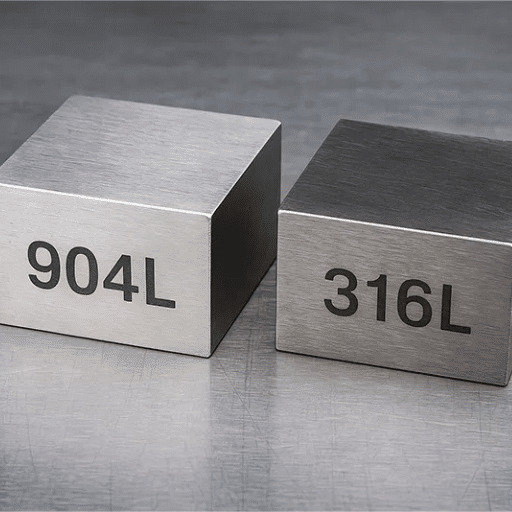
For the cluster’s full form-by-form price data, including coil, pipe and bar, and the nickel/molybdenum/copper cost decomposition, see our 904L price per kg page. If you are weighing 904L against a lower grade, our 904L vs 316L comparison covers the cost multiple and the selection framework.
Verifying 904L Plate: PMI, Ultrasonic Testing and the MTR
Documentation is where a 904L plate supplier proves the grade, and it is the single fastest way to separate a real mill relationship from a reseller.
PMI on Copper and Molybdenum
Portable testing on receipt should confirm the two elements a substitute grade fails first. 316L and 317L have no deliberate copper addition; 890L and various 6Mo grades sit at the edges. Incoming plate that reads Cu below 1.0% or Mo below 4.0% is not 904L:
- Copper: 1.0-2.0%
- Molybdenum: 4.0-5.0%
Priya, a receiving inspector at a chemical plant, ran PMI on a shipment of “904L” plate in 2025 and got Cu at 0.6%. The plate was a plausible-looking substitute, and the miss would have put a 317L-spec material into a sulfuric acid service where the copper content was doing real work.
Catching it at goods-in cost her an hour. Catching it after fabrication would have cost a project delay. PMI is cheap insurance on a plate whose rejection cost is measured in weeks.
Ultrasonic Testing: A435 for Thin, A578 for Plate
Ultrasonic testing practice splits by thickness. Thin sheet follows ASTM A435, while plate is examined under ASTM A578, which defines acceptance levels and is the reference vessel fabricators specify. Laminations and internal discontinuities are what you are screening for, and they matter most on plate destined for pressure duty. State the A578 acceptance level on the PO if your design code requires it.
The Documentation Package
Every 904L plate (UNS N08904) order should ship with:
- Material Test Report (MTR) with heat number, listing chemistry and mechanicals
- EN 10204 3.1 certification as standard; 3.2 for EPC or nuclear scope where an independent witness is required
- PMI / direct-reading spectrometer report targeting Cu and Mo
- UT report to A435 or A578 as specified
- Dimensional and thickness-gauge check per A480
Our nickel alloy material certificate page explains how the documentation package maps to what your QA department will ask for.
How to Write a 904L Plate Purchase Order

Paste this clause list into your RFQ and leave nothing to interpretation:
- Grade: 904L / UNS N08904 / EN 1.4539
- Governing standard: ASTM A240/A240M with A480/A480M (or EN 10088-2 / EN 10028-7 for PED scope)
- Chinese designation (if the MTR will read Chinese): S31782 / 015Cr21Ni26Mo5Cu2
- Form: plate (≥4.76 mm) or sheet (<4.76 mm)
- Thickness with the A480 tolerance basis stated
- Width × length, and whether slit edge or mill edge
- Quantity (pieces and total weight)
- Condition: solution annealed and pickled
- Finish: No.1 / 2B / BA as applicable
- Flatness requirement if fabricating to a fit-up constraint
- Certification: MTR, EN 10204 3.1 or 3.2, PMI, UT level
- NDT: A435 (thin) or A578 (plate) with acceptance level
- Marking, packing and destination
The designations in lines 1 and 3 are the ones you will see printed on the MTR, which is why our 904L equivalent grades reference is worth keeping beside the PO.
904L Plate Applications in Form
In plate form, 904L goes into vessel shells and heads, tank and absorber liners, tubesheets, and ducting where sulfuric or phosphoric acid service dominates. It’s a common choice for FGD absorber liners and wet-process phosphoric acid storage. Be honest about the limits: with a pitting resistance equivalent number around 34-36, 904L isn’t a warm-chloride or clean-seawater grade, and above about 40 °C in chloride service, 254 SMO or 2507 will outperform it. If your duty is on one face only, roll-bonded 904L-on-carbon-steel clad plate can reduce the 904L content to a liner thickness and cut material cost, which is worth raising with your supplier before you specify full thickness.
For the equipment-by-equipment application map, see our 904L applications guide.
904L Plate FAQ
Is 904L plate ASTM B625 or ASTM A240?
Both are cited, but only one governs today. ASTM B625-21 states that UNS N08904 products previously covered by B625 are now covered by A240/A240M and A480/A480M, because iron is the largest element by mass. B625 references to 904L are legacy and appear only in superseded editions, so new orders should cite A240.
What is the difference between 904L sheet and 904L plate?
Thickness and width. Plate is 4.76 mm and over and over 254 mm wide; sheet is under 4.76 mm and 609.6 mm or wider; strip is under 4.76 mm and under 609.6 mm wide. The boundary decides the processing route and the applicable tolerances.
What thickness does 904L plate come in?
Standard hot-rolled 904L plate runs 3.0 to 60 mm, with widths to 2000 mm. Heavier plate to 100 mm is made to order. Cold-rolled sheet starts around 0.3 mm.
What does 904L plate weigh per square metre?
About 7.98 kg per m² per mm of thickness, based on a density of 7.95-8.0 g/cm³. So 3 mm plate weighs roughly 24 kg/m², 10 mm about 80 kg/m², and 50 mm about 399 kg/m².
Can 904L plate be cut to size, and to what tolerance?
Yes. Shear holds about ±2 mm, slitting about ±1 mm, and plasma, laser or waterjet about ±0.5 mm. Choose the process based on what the edge has to do, not on cost alone.
What is the price of 904L plate per kg?
FOB China in 2026, roughly **6.80−9.20/kg∗∗dependingonthicknessandvolume,withabroadermarketbandof6.80−9.20/kg∗∗dependingonthicknessandvolume,withabroadermarketbandof4.80-9.20/kg. Certification and processing add-ons run to $0.40-0.90/kg. See our 904L price per kg page for the full breakdown.
Can 904L plate be welded?
Yes, with matching consumables and appropriate heat input. Because of its chemistry and the quench-sensitive condition, weld procedure qualification matters. Our 904L welding guide covers filler selection and procedure details.
Is 904L plate suitable for vessels, tanks and FGD absorbers?
For sulfuric and phosphoric acid service, yes. For warm chloride or clean seawater above about 40 °C, no; specify 254 SMO or 2507 instead. State the operating medium and temperature and we will confirm suitability before you specify.
Conclusion
904L stainless steel plate is a well-defined grade wrapped in a poorly-defined market. The five decisions that carry the order are: cite ASTM A240/A240M with A480/A480M rather than the legacy B625; know whether you are buying plate (≥4.76 mm) or sheet; quote the A480 thickness, width and flatness tolerance instead of a percentage; specify No.1 finish, solution annealed and pickled, explicitly; and verify copper and molybdenum by PMI on receipt. Get those five right and the plate that arrives is the plate your vessel was designed around.
Send your plate specification, thickness, tolerance, finish and quantity, and our team will confirm availability, cut-to-size tolerance and a certified quotation with MTR and PMI within 24 hours.
Request a certified 904L plate quotation and put the five lines on the order sheet where they belong.